
3.5.18 How Do I Customize the C Runtime Startup Code?
Some applications may require an application-specific version of the C runtime startup code. For instance, you may want to modify the startup code for an application loaded by a bootloader.
To customize the startup code for your application, you will first need to obtain the source code for the default startup code.
- Unzip the
pic32m-libs.zip file located in
the<install-directory>/pic32-libs/ directory. If the
tar files within this archive are not automatically expanded by your archive
utility, you might need to run
tar -xvfor an alternative application on these tar files. The runtime startup source code can then be found at pic32m-libs/pic32m-libs/pic32m-libs/libpic32/startup/crt0.S in the unzipped directory, although note that some archive utilities might expand the files in directories with slightly different names. - Make a copy of the unarchived crt0.S file, rename it, and add it to your project.
- Change your MPLAB X project to
exclude the default startup code by enabling the Do not link startup
code checkbox in the Libraries Option
category under xc32-ld , as shown below. When you build your
project, the MPLAB X IDE will build your new application-specific copy of the
startup code rather than linking in the default code.
Figure 3-1. Startup Code Properties Setting 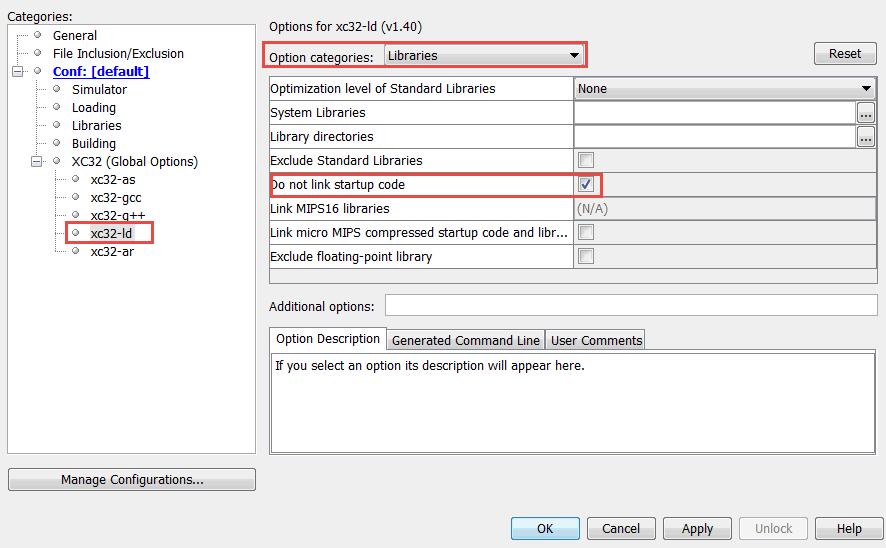
- You can now edit the assembly code in
your new copy of the runtime startup file. The default source code uses macros
defined in the device-specific header files, which are included by
<xc.h>. These macros define various device specific behavior. Be sure to take this device-specific code into account when customizing your copy of the code.Table 3-1. Device-Specific Macros Device-Specific Macro Description __PIC32_SRS_SET_COUNTDefined to the number of Register Sets implemented on the device. The default startup code uses this value to determine how many register sets to use for $GP-register initialization. __PIC32_HAS_L1CACHEDefined if the device features an L1 cache. __PIC32_HAS_MIPS32R2Defined if the device supports the MIPS32r2 Instruction Set. __PIC32_HAS_MICROMIPSDefined if the device supports the microMIPS compressed Instruction Set. __PIC32_HAS_DSPR2Defined if the device supports the DSPr2 Application-Specific Extension. __PIC32_HAS_FPU64Defined if the device supports the single- and double-precision hardware Floating Point Unit. __PIC32_HAS_SSXDefined if the device does not require initialization of the bus matrix registers in order to support execution from data memory. __PIC32_HAS_MMU_MZ_FIXEDDefined if the device features a Memory Management Unit that should be pre-initialized to a standard SQI and EBI mapping. __PIC32_HAS_INIT_DATADefined if the device requires data initialization by copying from a template located in Flash to RAM.