
19.4.2.1 DMA
The DMAC transfers data between memory and peripherals without CPU intervention. The data transferred performed by the DMAC are called transactions, and these transactions can be divided into smaller data transfer units. The following figure illustrates the relationship between the different transfer sizes:
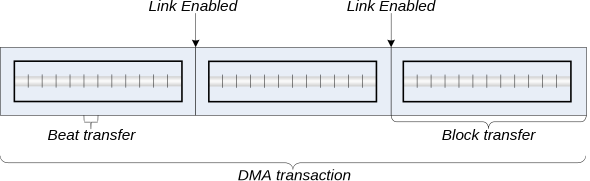
- Beat transfer — The size of a single data transfer bus access. The size is selected by writing to the Beat Size bit field in the Block Transfer Control (BTCTRL.BEATSIZE) register
- Block transfer — The amount of data that one transfer descriptor can transfer, ranging from 1 to 64k beats. A block transfer can be interrupted by another channel with a higher priority level.
- Transaction — The DMAC can link multiple transfer descriptors by having each descriptor point to the next, as shown in the figure above. A DMA transaction is the complete transfer of all blocks within a linked list.
A transfer descriptor specifies the parameters for a block transfer executed by the DMAC and must be stored in SRAM. Refer to the Transfer Descriptors section for additional details about the transfer descriptor.
The figure above shows several block transfers linked together, referred to as linked descriptors. Refer to the Linked Descriptors section for additional information about linked descriptors.
A DMA transaction is initiated by an incoming transfer trigger on one of the DMA channels. This trigger can be configured as a software trigger, an event trigger, or a dedicated peripheral trigger. The transfer trigger generates a DMA transfer request from the corresponding channel to the arbiter. If multiple DMA channels have pending transfer requests, the arbiter selects which channel is granted access and becomes the active channel. The active channel then performs the transaction according to the configuration in the transfer descriptor. An ongoing transaction can be interrupted by a higher-priority channel. When the lower-priority channel transaction is granted access again as the active channel, the interrupted block transfer resumes.
For each beat transfer, an optional event output can also be generated. For each block transfer, optional interrupts and an optional event output can be generated. When a transaction is completed, the DMA channel is either suspended or disabled, depending on the configuration.