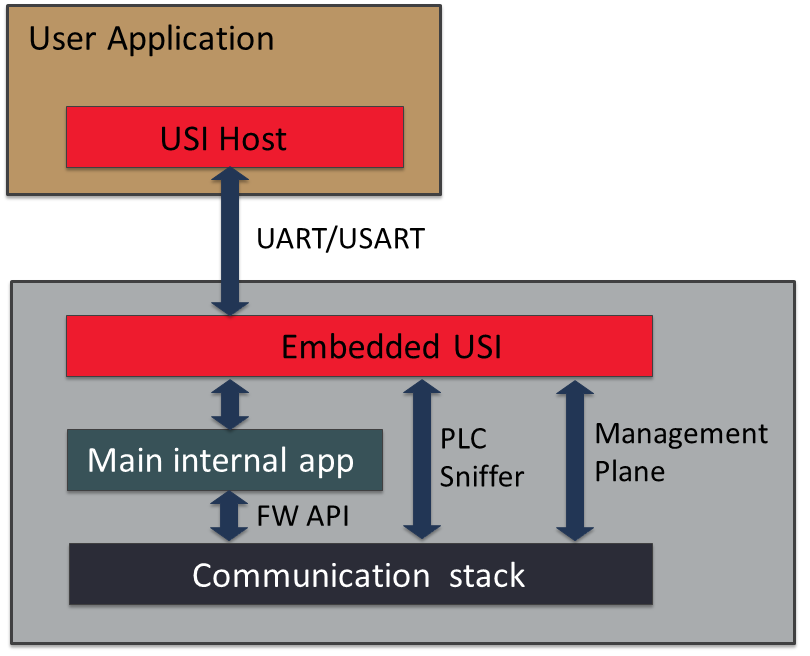
The USI enables communication between any external user application and the embedded firmware
stacks through multiple serial ports. Therefore, when an external application
communicates with the Microchip communication stacks implemented through a serial
device, the typical resulting structure is illustrated in the figure below.Figure 1-1. USI Architecture
As indicated in the preceding image, the USI is divided into two parts:
Embedded USI: The wrapper
part of the Hardware Abstraction Layer (HAL) is responsible for the interface
between the firmware stack and the serial communications channel. It can also be
used by the main internal application to communicate through the serial
port.
USI Host: An example of
wrapper to be integrated in the external application which allows to interface
with the Microchip PLC firmware stacks using the serial communication channel.
It is written in C programming language, and it can run in an embedded system
(either bare-metal or Linux®) or in a general purpose computer. The user can
also develop their own independent implementation of the USI Host following the
indications of this user's guide and examples.
Important: This User's Guide
describes the USI Host example implementation written in C programming language. Another
possibility to communicate with the USI serialized interface of the Microchip
communication stacks is to use the Python libs. These libraries provide a simple way to
develop scripts in Python Language that make use of the Microchip communication stacks
primitives through a serial connection.
The online versions of the documents are provided as a courtesy. Verify all content and data in the device’s PDF documentation found on the device product page.