
3.3.1 How the EMAFE Peripheral Library Works
- Up to two-phase energy metering analog front-end suitable for Microchip MCUs and metrology library.
- Compliant with Class 0.2 standards (ANSI C12.20-2002 and IEC 62053-22) metering accuracy classes.
- Five Sigma-Delta ADC measurement channels: two voltages (V1, V2), two currents (I1, I2), and one temperature channel (I0), 102 dB dynamic range.
- Pre-gain (x1, x2, x4, x8) amplifiers on current channels.
- Supports shunt, current transformer and Rogowski coils.
- Integrated 2.8V LDO regulator to supply analog functions.
- Integrated SINC decimation filters.
- Precision Voltage Reference (INT_REF_VOLTAGE = 1.144V).
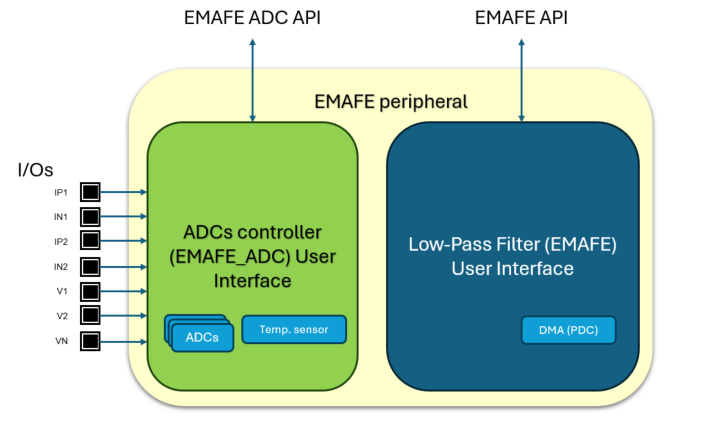
The EMAFE ADCs controller configures the on-die ADC converters, temperature sensor and voltage reference and LDO.
The ADCs convert voltage, current and temperature. One ADC input is directly driven by an on-chip temperature sensor.
All ADC channels are built around the same Sigma-Delta A/D converter. The voltage reference of this converter is the VREF_AFE pin voltage with a reference to ground (GNDA pin). This reference voltage can be internally or externally sourced. The converter sampling rate is MCLK_AFE/4, typically 1.024 MHz. An external low-pass filter, typically a passive R-C network, is required at each ADC input to reject frequency images around this sampling frequency (anti-alias).
The Low-Pass Filter Interface (LPFIF) provides a means to transfer data from filters to system memory. Two methods to transfer data from the filters to the memory system are available:
- Direct Transfer: Data are read directly in the channel-dedicated registers (EMAFE_DATAx) as soon as data is ready (EMAFE_ISR.DRDY=1). When enabled, an interrupt is generated when data is ready.
- DMA Transfer: Data from the filters are loaded in a FIFO (EMAFE_DMA_DATA) and a request (trigger event) is sent to the DMA as soon as new data is ready.