
3.2 Single Event Effects (SEE) Performance
This device has been characterized for SEE with heavy ions. The following SEE safe-operating area profile has been established using the ions, linear energy transfer (LET), range, and total energy conditions shown.
| Ion Species |
Eff. Surface LET |
Beam Energy |
Eff. Range | VDS (V) | ||||
|---|---|---|---|---|---|---|---|---|
| VGS = 0V | VGS = –5V | VGS = –10V | VGS = –15V | VGS–20V | ||||
| Ag | 44(±5%) | 1330(±5%) | 117(±5) | 235 | 235 | 235 | 235 | 235 |
| Xe | 63.9(±5%) | 946(±5%) | 70(±7.5%) | 200 | 200 | 200 | 200 | — |
| Au | 90.0(±5%) | 1489(±5%) | 83(±5) | 190 | 190 | — | — | — |
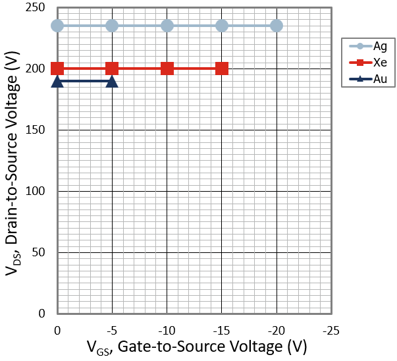
Microchip Radiation-Hardened MOSFETs are tested in a manner to provide maximum observability during heavy ion exposure. The filtering circuits of MIL-STD-750F Method 1080 are not used.
A VGS/VDS point is accepted on the prior plot if all of the
following conditions are met:
- A fluence of 3×10⁵ ±20% ions/cm2 is delivered to each sample
- No single event burnout is detected via continuous monitoring of the drain current
- No single event gate rupture is detected via continuous monitoring of the gate current
- Post-exposure IDSS tests continue to pass specification
- Post-exposure IGSS test continue to pass specification