
2 Hardware Overview
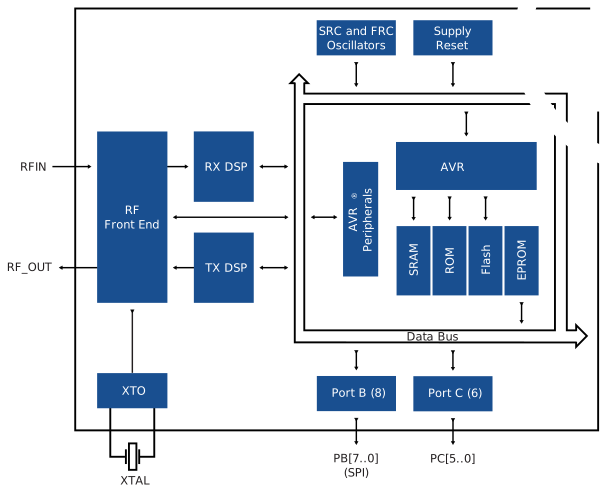
The ATA8510/ATA8515 product family addresses the requirements discussed in the Introduction. The focus remains on the transceiver (ATA8510/ATA8515) device, which covers both receiver and transmitter functionalities. Everything related to the receiver applies to the ATA8210/ATA8215 products, and everything related to the transmitter applies to the ATA8710 products.
The ATA8510 product family offers two receiver inputs, one for low-band applications and one for high-band applications. The architecture defines low band as frequencies below 500 MHz and high band as frequencies above that threshold. The transmitter side features a power amplifier output pin that covers the entire sub-GHz frequency range. Additionally, the built-in Single Pole, Double Throw (SPDT) provides switching capabilities. This hardware delivers maximum flexibility for multi-frequency applications.
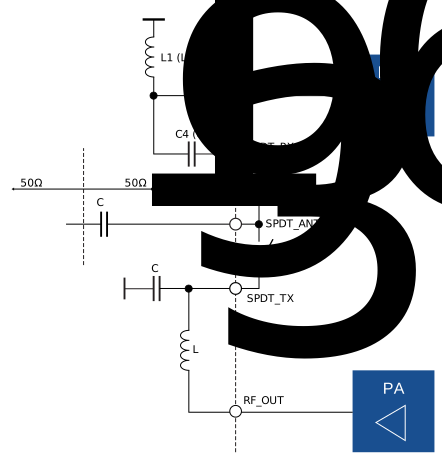
| RF Term | Description |
|---|---|
| Antenna (ANT) | Physical antenna connection |
| RF Input High Band (RFIN_HB) | Input for high-band RF signals |
| RF Input Low Band (RFIN_LB) | Input for low-band RF signals |
| RF Out (RFOUT) | Output for transmitting RF signals |
| Single Pole Double Throw (SPDT) | Switch for routing signals between two paths |
| Input/Output Pin | Frequency Range(s) |
|---|---|
| RFIN_LB |
|
| RFIN_HB |
|
| RFOUT |
|
Note: The same Crystal Oscillator (XTO) frequency (24.305 MHz) supports all frequencies. Under special conditions, changing the crystal frequency may become necessary, as indicated by the EEPROM configuration Graphical User Interface (GUI). For more details, refer to the AN4203-ATA8510 Configuration Tool Guide (DS00004203). | |