1.3.1 PIC32CZ-CA80 Curiosity Ultra Board: Building and Running the USB Live Update Applications
Downloading and Building the Application
To clone or download these application from Github, go to the main page of this repository and then click Clone button to clone this repo or download as zip file. This content can be download using content manager by following these instructions.
Path of the application within the repository is apps/usb_live_update/.
To build the application, refer to the following table and open the project using its IDE.
Switcher Application
| Project Name | Description |
|---|---|
| switcher/firmware/pic32cz_ca80_curiosity_ultra.X | MPLABX Project for PIC32CZ-CA80 Curiosity Ultra board |
Live Update Application
| Project Name | Description |
|---|---|
| live_update_app/firmware/pic32cz_ca80_curiosity_ultra.X | MPLABX Project for PIC32CZ-CA80 Curiosity Ultra board |
Setting Up PIC32CZ-CA80 Curiosity Ultra board
Connect the Debug USB port on the board to the computer using a micro USB cable
Use TARGET USB(J102) connector on the board to connect the USB Device to the USB Host PC
Running the Application
Open the Terminal application (Ex.:Tera Term) on the computer to get live update application messages through UART once loaded.
Configure the serial port settings as follows:
- Baud: 115200
- Data: 8 Bits
- Parity: None
- Stop: 1 Bit
- Flow Control: None
Open the switcher application project switcher/firmware/pic32cz_ca80_curiosity_ultra.X in the IDE.
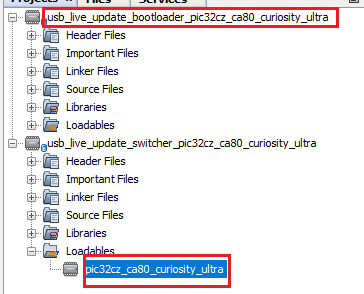
Ensure that the live_update_app/firmware/pic32cz_ca80_curiosity_ultra.X is added as a loadable project to switcher application.
- As the Switcher application does not have any programming capabilities. Adding the live_update_app as loadable allows MPLAB X to create a unified hex file and program both these application in thier respective memory location based on the respective linker scripts.
LED0 should start blinking once programming is completed and below message has to be displayed on the Console.
- The user can see how the live update application was loaded in BANK A by IDE
- HID Custom device with product ID 3C will be enumerated on Host PC

Launch the Unified Host application from below path:
- <harmony3_path>/bootloader/tools/UnifiedHost-*/UnifiedHost-*.jar
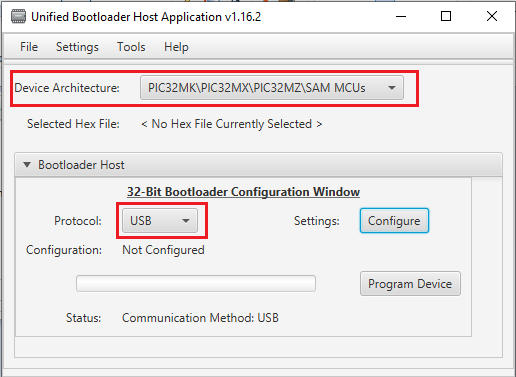
Configure the Unified host application.
Select the Device architecture and Protocol as shown below
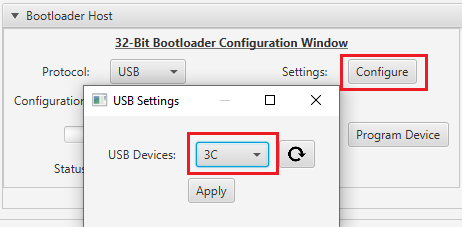
Click the Configure button and select the USB Device as 3C
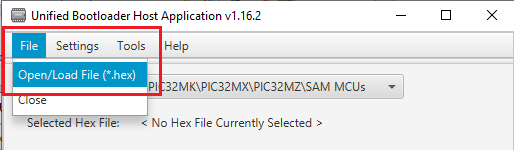
Load the live update application hex file to be programmed using below option
- <harmony3_path>/bootloader_apps_usb/apps/usb_live_update/live_update_app/firmware/pic32cz_ca80_curiosity_ultra.X/dist/sam_e54_xpro/production/pic32cz_ca80_curiosity_ultra.X.production.hex
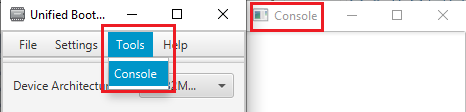
Open the Console window of the host application to view application bootloading sequence
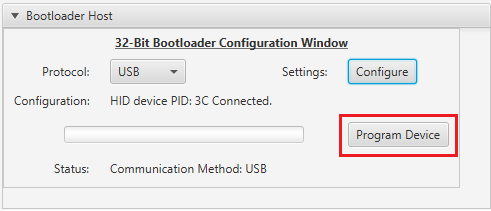
Click the Program Device button to program the loaded live update application hex file on to the device.
- The user can note that throughout the programming sequence and after programming the LED0 will be blinking as the application task is running along with bootloader task (Live Update Feature)
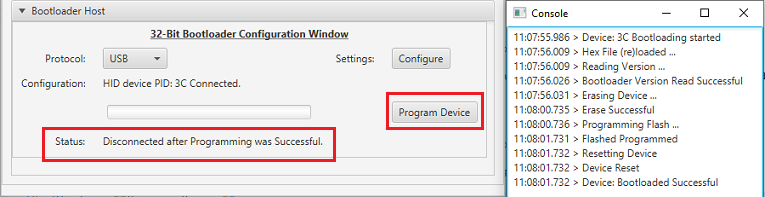
Following figure shows output of successfully programming the test application.
- Ignore the Device Reset Messages from the host tool. The live update application ignores the reset command received and waits for a switch press to update serial number and reset.
Press the Switch SW0 to update serial of Inactive Bank and trigger reset. The user should see below output on success.
- This step shows that the new firmware programmed in BANK B is running which is mapped to lower region by switcher at reset

Repeat Steps 8-10 for further updates and observe the Banks from which application is running at every update.
Configurations to be Noted
Switcher Application
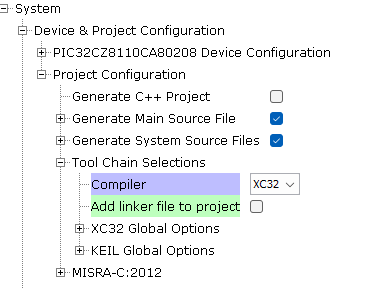
- As we are using custom linker script for Switcher, the default linker file generation has to be disabled
Live Update Application
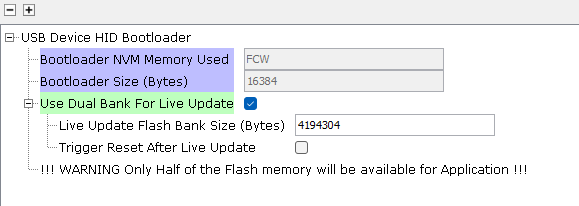
- Enable Live Update Option to configure USB Device HID bootloader in Live Update Mode
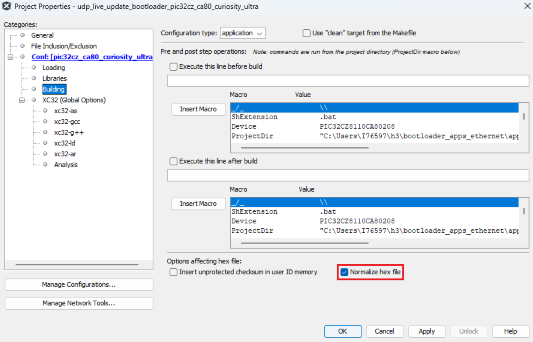
- Normalize hex file:
- Check the Normalize hex file option as shown below, as the Unified bootloader host application takes hex file as an input. Normalizing the hex file will ensure the data in the hex file is arranged sequentially.