
Introduction
| Author: | Muhsin Vilangappurath, Microchip Technology Inc. |
In the realm of power converters, control loops assume a pivotal role in influencing the performance of switching regulators (see Figure ). Ongoing efforts to enhance power supply designs have catalyzed the evolution of control techniques. Microchip's Hyper Speed Control®, also recognized as Adaptive Constant-On-Time control, stands out among these innovative control methods, boasting advancements in tighter regulation, improved transient response, ease of design, and cost-effectiveness.
This application note is organized into two parts. The first part introduces the fundamentals of Adaptive Constant-On-Time (ACOT™) control and describes the basic operating principles and ripple-injection methods used in buck converters. The second part presents detailed design guidelines, including ripple-injection design criteria, stability considerations, control-loop analysis, and techniques for optimizing converter performance.
Voltage Mode Control (VMC), Current Mode Control (CMC), and Hysteretic Mode Control are three prominent methodologies employed in buck converters. VMC operates by adjusting the duty cycle based on the comparison between the output voltage and a reference voltage, offering simplicity and stability under steady-state conditions but exhibiting limitations in response time to external changes. In contrast, CMC modulates the duty cycle based on the inductor current, providing inherent current limiting for improved transient response, wider adaptability to input voltage variations, and enhanced noise immunity.
However, CMC's design complexity and susceptibility to subharmonic oscillations and limitations in very low duty cycle operation must be considered. Hysteretic Mode Control, also known as On-Off Control or bang-bang control, toggles the power switch based on the comparison between the output voltage and predefined thresholds (as illustrated in Figure ). It provides fast transient response with simplicity and robustness.
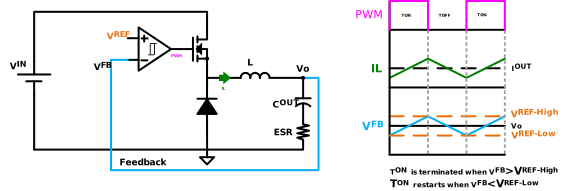
Constant-On-Time (COT) control stands out as an effective method for implementing hysteretic control. It offers a robust and straightforward approach, making it well-suited for various power electronics applications. COT control operates by maintaining a constant on-time for the power switch, which results in self-adjusting switching frequencies based on input voltage and load conditions. This adaptability ensures stable performance across varying operational parameters.
Due to its simplicity, reliability, and versatility, COT control has gained widespread popularity and is commonly used in numerous power supply designs and voltage regulation systems. Its widespread use highlights its effectiveness as a control methodology in modern power electronics applications.