This is the tab shown while the test is being executed; it shows the
transmission or reception of each message in form of a table. The following figures show
examples of this tab for transmission and a reception tests.
Both views (Tx and Rx) show tables representing different information
depending on test type (transmission/reception). When the test is finished or is cancelled,
a final report is shown at the bottom of the tab.
This tab will provide additional information about signal quality in case
of selecting "Performing EVM Test" check-box in the Reception Parameters tab.
The user can copy the information included in the corresponding table to
the clipboard by clicking on the Copy Table button. This tab is only able to hold
the information of the last 10000 frames; the user can choose a bigger number of frames to
be transmitted/received. However, only the last 10000 frames will be available.
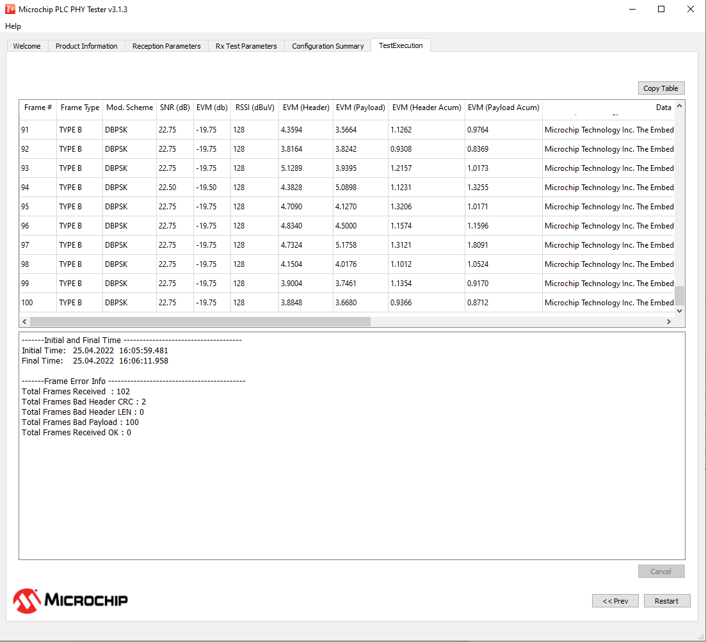
Reception Test Results
Figure 1-48. Execution Tab for PRIME PHY
Layer Rx Test
Information included in the table is as follows:
Frame #: Indicates the received
frame number
Frame Type: Indicates the frame
type: Type A, Type B and Type BC
Modulation Scheme: Indicates if
modulation scheme
SNR (dB): Signal-to-Noise ratio
calculated as PRIME 1.4 Spec
EVM (dB): Error Vector
Magnitude calculated as PRIME 1.4 Spec
RSSI (dBuV): Indicates the
strength of the received signal in dBuV
Data: Is the received info in
ASCII format
Rx Interval: Is the interval of
time between the reception of the current frame and the previous one
Payload Integrity: Shows if the
content of the frame is correct or not
After all frames have been received, or the test has been cancelled,
a text box with information about the test will be shown at the bottom of the tab.
First of all, test timestamps are shown; this information is measured by the PC
application. After that, there is a section called Frame Error information that shows
information about received frames and possible errors. Fields shown in this section
are:
Total Frames Received: Shows
the number of frames detected, not taking into account if the frame has
errors
Total Frames Bad Header CRC:
Shows the number of frames in which the header CRC8 is not valid. These frames
are discarded by the firmware and are not reported in the application
Total Frames Bad Header LEN:
Shows the number of frames in which the header LEN is not correct. These frames
are discarded by the hardware and are not reported in the application
Total Frames Bad Payload: Shows
the number of frames where the content of the payload is not what it is
supposed to be
Total Frames Received OK: Shows
the number of frames received with the correct content
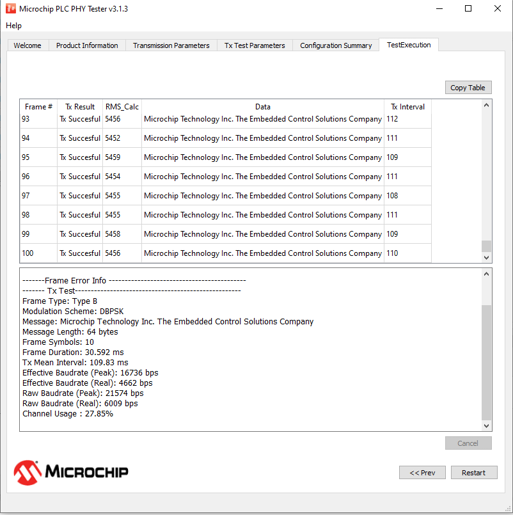
Transmission Test Results
Figure 1-49. Execution Tab for PRIME PHY
Layer in Tx Test
There are eight columns that show the following information:
Frame #: Indicates the number
of frames transmitted. It is useful to track the test progress
Tx Result: Indicates the result
of the transmission. If an error occurs, a descriptive text will appear
RMS_Calc: This number is
related with the impedance detected in the power line; it is used by the PHY
layer to determine the Transmission mode
Data: Shows the message
received in ASCII format
Tx Interval: Represents the
time interval between the current frame and the previous one
After all frames have been transmitted, a text box with information
about the test will appear at the bottom of the tab.
Test timestamps are provided; this information is measured by the PC application.
After that, there is a section of information called Frame Error information that
shows information about transmitted frames and possible errors. Finally, another
section shows a summary of the transmission test; apart from known transmission
parameters other parameters are shown:
Frame Symbols: Is the duration
in symbols of the frame
Frame Duration: Is the duration
in millisecond of the frame
Tx Mean Interval: Is the
average interval between transmissions calculated from top table data
Effective Baudrate (Peak): Is
the effective baudrate if frames were transmitted consecutively, calculated as
following:
Effective Baudrate (Real): Is
the effective baudrate, calculated as following:
Raw Baudrate (Peak): Is the
baudrate taking into account all headers that previous baudrates have not
considered if frames were transmitted consecutively, calculated as
following:
Raw Baudrate (Real): Is the
baudrate taking into account all headers that previous baudrates have not
considered, calculated as following:
Channel Usage : Is the
percentage of channel that has been used, calculated as following: