1.5.1 Configuring an Application to Be Bootloaded for MIPS Based MCUs
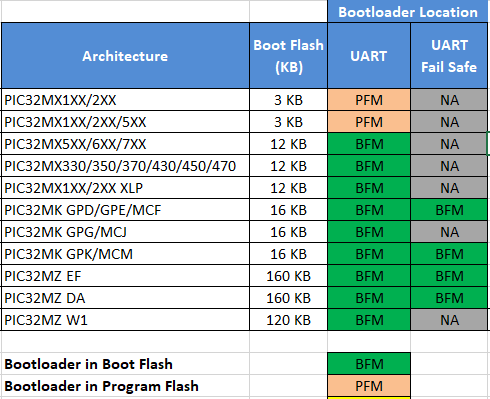
Bootloader Placement for Various PIC32M Product Families
The bootloader is placed in BFM or PFM based on the size of the bootloader and available BFM on the device.
-
If the bootloader fits into the available BFM, it is placed in BFM. The user application can use the complete area of the PFM.
-
If the bootloader does not fit into the available BFM, it is placed in PFM. The user application can use the remaining area of the PFM.
-
The following table shows the available BFM and the placement of different bootloaders by product family
Setting Up the Application Linker Script
The linker script file of the application project has to be modified to place the vector table and reset handlers in PFM.
-
For Quick start, refer to the pre developed application linker scripts app_XX.ld placed in projects device specific configuration folder of bootloader_apps_xxx/ repository
-
Reset Address for the application to be loaded through bootloader should match the Application start address mentioned in bootloader project
-
The vector address of a given interrupt is calculated using Exception Base (EBASE) CPU register and the _ebase_address should be aligned to 4 KB boundary
For Bootloaders Placed in Boot Flash Memory (PIC32MZ and PIC32MK Devices)
-
The application start address by default will be start of PFM
- Refer to the specific device Data Sheet for PFM start address and length
-
The Initial 4 KB from Application start address are used by Reset Handler and cache_init section
-
XC32 Compiler calculates offset from the EBASE address and initializes the value of interrupt vector offset (OFFx) register. The offset register is combined with EBASE register using a bitwise OR operator to obtain the interrupt vector address that the CPU will jump to when the corresponding interrupt occurs.
-
If the EBASE address is aligned to 4 KB, then all the interrupt vectors must be located within the 4 KB from base address.
- For example, when _ebase_address is set to 0x9D001000 and interrupts vectors are not located withing the 4 KB boundary from the ebase address (OFFx > 0x1000), then the bitwise OR operator may not provide correct interrupt vector address.
-
To provide maximum flexibility in placement of interrupt vectors:
-
Always place the _ebase_address at start of PFM (e.g., 0x9D000000), such as the default linker script
-
Change the offsets of exceptions and vector section to place them after the device startup code. With this the interrupt handlers can be located anywhere in the PFM.
-
-
Updated linker scripts as explained above is shown here as an example
PROVIDE(_vector_spacing = 0x0001);
PROVIDE(_ebase_address = 0x9D000000);

/* Place the vector table and other exceptions after the device reset and
 * cache init code.
 */
PROVIDE(_ebase_vector_offsets = 0x1000);

_RESET_ADDR                    = 0xBD000000;
_SIMPLE_TLB_REFILL_EXCPT_ADDR  = _ebase_address + _ebase_vector_offsets + 0;
_CACHE_ERR_EXCPT_ADDR          = _ebase_address + _ebase_vector_offsets + 0x100;
_GEN_EXCPT_ADDR                = _ebase_address + _ebase_vector_offsets + 0x180;

kseg0_program_mem  (rx) : ORIGIN = 0x9D001000, LENGTH = 0x200000 - 0x1000

kseg1_boot_mem          : ORIGIN = 0xBD000000, LENGTH = 0x480

kseg1_boot_mem_4B0      : ORIGIN = 0xBD0004B0, LENGTH = 0x1000 - 0x4B0

/* Boot Sections */
.reset _RESET_ADDR :
{
  KEEP(*(.reset))
  KEEP(*(.reset.startup))
} > kseg1_boot_mem

.cache_init :
{
  *(.cache_init)
  *(.cache_init.*)
} > kseg1_boot_mem_4B0
...

/* Interrupt vector table with vector offsets */
.vectors _ebase_address + _ebase_vector_offsets + 0x200 :
{
  /*  Symbol __vector_offset_n points to .vector_n if it exists,
   *  otherwise points to the default handler. The
   *  vector_offset_init.o module then provides a .data section
   *  containing values used to initialize the vector-offset SFRs
   *  in the crt0 startup code.
   */
  . = ALIGN(4) ;
  __vector_offset_0 = (DEFINED(__vector_dispatch_0) ? (. - _ebase_address) : __vector_offset_default);
  KEEP(*(.vector_0))
  ...
  ...
  /* Default interrupt handler */
  . = ALIGN(4) ;
  __vector_offset_default = . - _ebase_address;
  KEEP(*(.vector_default))
} > kseg0_program_mem
For Bootloaders Placed in Program Flash Memory (PIC32MK Devices)
-
The bootloader code resides from start of PFM. Therefore, the application start address has to be after the end of bootloader
- Refer to the specific device Data Sheet for PFM start address and length
-
The Initial 4 KB from Application start address are used by Reset Handler section
-
XC32 Compiler calculates offset from the EBASE address and initializes the value of interrupt vector offset (OFFx) register. The offset register is combined with EBASE register using a bitwise OR operator to obtain the interrupt vector address that the CPU will jump to when the corresponding interrupt occurs.
-
If the EBASE address is aligned to 4 KB, then all the interrupt vectors must be located within the 4 KB from base address
- For example, when _ebase_address is set to 0x9D001000 and interrupts vectors are not located withing the 4 KB boundary from the ebase address (OFFx > 0x1000), then the bitwise OR operator may not provide correct interrupt vector address.
-
To provide maximum flexibility in placement of interrupt vectors:
-
Always place the _ebase_address at start of PFM (e.g., 0x9D000000), such as the default linker script
Note: As _ebase_address is only used to calculate the vector offset it can be placed at start of PFM even though the bootloader code is residing there. -
Change the offsets of exceptions and vector section to place them after the device startup code of application. With this the interrupt handlers can be located anywhere in the PFM after bootloader space.
-
-
Updated linked scripts as explained above is shown here as an example
- Bootloader length <bootloader_length> in the below snippet needs to be replaced with size of the respective bootloader
PROVIDE(_vector_spacing = 0x0001);
PROVIDE(_ebase_address = 0x9D000000);

/* Place the vector table and other exceptions after the device reset and
 * cache init code.
 */
PROVIDE(_ebase_vector_offsets = <bootloader_length> + 0x1000);

_RESET_ADDR                    = 0xBD000000 + <bootloader_length>;
_SIMPLE_TLB_REFILL_EXCPT_ADDR  = _ebase_address + _ebase_vector_offsets + 0;
_GEN_EXCPT_ADDR                = _ebase_address + _ebase_vector_offsets + 0x180;

kseg0_program_mem  (rx) : ORIGIN = 0x9D000000 + <bootloader_length> + 0x1000, LENGTH = 0x200000 - <bootloader_length> - 0x1000

kseg1_boot_mem          : ORIGIN = 0xBD000000 + <bootloader_length>, LENGTH = 0x1000

/* Boot Sections */
.reset _RESET_ADDR :
{
  KEEP(*(.reset))
  KEEP(*(.reset.startup))
} > kseg1_boot_mem

...

/* Interrupt vector table with vector offsets */
.vectors _ebase_address + _ebase_vector_offsets + 0x200 :
{
  /*  Symbol __vector_offset_n points to .vector_n if it exists,
   *  otherwise points to the default handler. The
   *  vector_offset_init.o module then provides a .data section
   *  containing values used to initialize the vector-offset SFRs
   *  in the crt0 startup code.
   */
  . = ALIGN(4) ;
  __vector_offset_0 = (DEFINED(__vector_dispatch_0) ? (. - _ebase_address) : __vector_offset_default);
  KEEP(*(.vector_0))
  ...
  ...
  /* Default interrupt handler */
  . = ALIGN(4) ;
  __vector_offset_default = . - _ebase_address;
  KEEP(*(.vector_default))
} > kseg0_program_mem
For Bootloaders Placed in Boot Flash Memory (PIC32MX Devices)
-
The application start address by default will be start of PFM
- Refer to the specific device Data Sheet for PFM start address and length
-
The Initial 4 KB are used by Reset Handler section
-
In PIC32MX devices the _ebase_address holds the start address of vector table and it must be placed at 4 KB boundary after the Reset Handler section
-
Updated linked scripts as explained above is shown here as an example
PROVIDE(_vector_spacing = 0x0001);
PROVIDE(_ebase_address = 0x9D001000);

_RESET_ADDR                 = 0xBD000000

kseg0_program_mem     (rx)  : ORIGIN = 0x9D001000, LENGTH = 0x80000 - 0x1000
kseg1_boot_mem              : ORIGIN = 0xBD000000, LENGTH = 0x1000

/* Boot Sections */
.reset _RESET_ADDR :
{
  KEEP(*(.reset))
  KEEP(*(.reset.startup))
} > kseg1_boot_mem
...

.vector_0 _ebase_address + 0x200 + ((_vector_spacing << 5) * 0) :
{
   KEEP(*(.vector_0))
} > kseg0_program_mem
ASSERT (_vector_spacing == 0 || SIZEOF(.vector_0) <= (_vector_spacing << 5), "function at exception vector 0 too large")

.vector_1 _ebase_address + 0x200 + ((_vector_spacing << 5) * 1) :
{
   KEEP(*(.vector_1))
} > kseg0_program_mem
ASSERT (_vector_spacing == 0 || SIZEOF(.vector_1) <= (_vector_spacing << 5), "function at exception vector 1 too large")
...
...
For Bootloaders Placed in Program Flash Memory (PIC32MX Devices)
-
The bootloader code resides from start of PFM. Therefore, the application start address has to be after the end of bootloader.
-
The Initial 4 KB from Application start address are used by Reset Handler section
-
Place the _ebase_address after the device startup code of application
-
Updated linked scripts as explained above is shown here as an example
- Bootloader length <bootloader_length> in the below snippet needs to be replaced with size of the respective bootloader
PROVIDE(_vector_spacing = 0x0001);
PROVIDE(_ebase_address = 0x9D000000 + <bootloader_length> + 0x1000);

_RESET_ADDR                 = 0xBD000000 + <bootloader_length>;

kseg0_program_mem     (rx)  : ORIGIN = 0x9D000000 + <bootloader_length> + 0x1000, LENGTH = 0x80000 - <bootloader_length> - 0x1000
kseg1_boot_mem              : ORIGIN = 0xBD000000 + <bootloader_length>, LENGTH = 0x1000

/* Boot Sections */
.reset _RESET_ADDR :
{
  KEEP(*(.reset))
  KEEP(*(.reset.startup))
} > kseg1_boot_mem
...

.vector_0 _ebase_address + 0x200 + ((_vector_spacing << 5) * 0) :
{
   KEEP(*(.vector_0))
} > kseg0_program_mem
ASSERT (_vector_spacing == 0 || SIZEOF(.vector_0) <= (_vector_spacing << 5), "function at exception vector 0 too large")

.vector_1 _ebase_address + 0x200 + ((_vector_spacing << 5) * 1) :
{
   KEEP(*(.vector_1))
} > kseg0_program_mem
ASSERT (_vector_spacing == 0 || SIZEOF(.vector_1) <= (_vector_spacing << 5), "function at exception vector 1 too large")
...
...
-
The bootloader and the application must have the same device configuration bit settings. The Device configuration bit settings from the bootloader project will be updated by the programmer/debugger. Therefore, the application linker script should not have any device configuration bit settings. The application project will use the device configuration bit settings done by bootloader.
-
Device configurations and debug exception need to discarded from final hex file for the application project.
/DISCARD/ : { *(._debug_exception) }
/DISCARD/ : { *(.config_*) }
Additional Settings (Optional)
Data Memory Origin and Data Memory Length values should be updated in linker script for reserving configured bytes from start of RAM to trigger bootloader from firmware.
/* Reserve <trigger_len> Bytes to Store Bootloader Trigger Pattern */
kseg0_data_mem       (w!x)  : ORIGIN = <ram_start> + <trigger_len>, LENGTH = <ram_length> - <trigger_len>
MPLAB X Settings
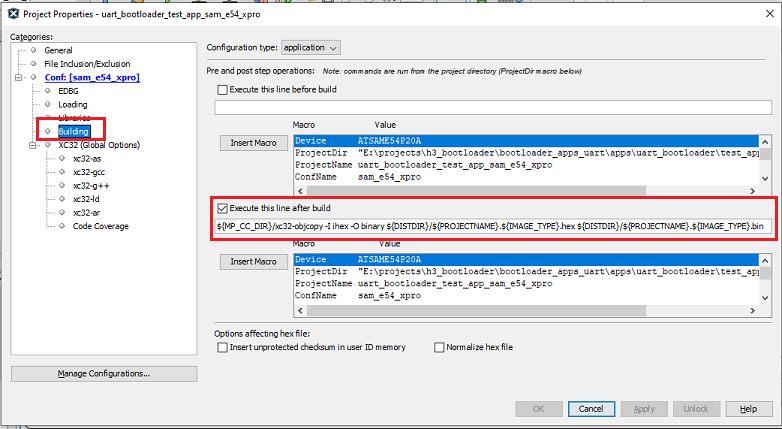
Specifying post build option to automatically generate the binary file from hex file once the build is complete.
${MP_CC_DIR}/xc32-objcopy -I ihex -O binary ${DISTDIR}/${PROJECTNAME}.${IMAGE_TYPE}.hex ${DISTDIR}/${PROJECTNAME}.${IMAGE_TYPE}.bin