
4.4 Firmware – Safe Start
To ensure a safe and controlled start-up of the LLC converter, PWM Generator 1 (PG1) is initially configured to generate narrow pulses, with the PWM enabled at a frequency of 1.6 MHz. The start-up sequence proceeds by gradually increasing the PGPER register value, which results in a corresponding increase in output voltage as the switching period is extended. The primary period value is then written to the secondary period register. It is important to note that, in independent mode, using the same period value results in twice the frequency compared to the push-pull output mode.
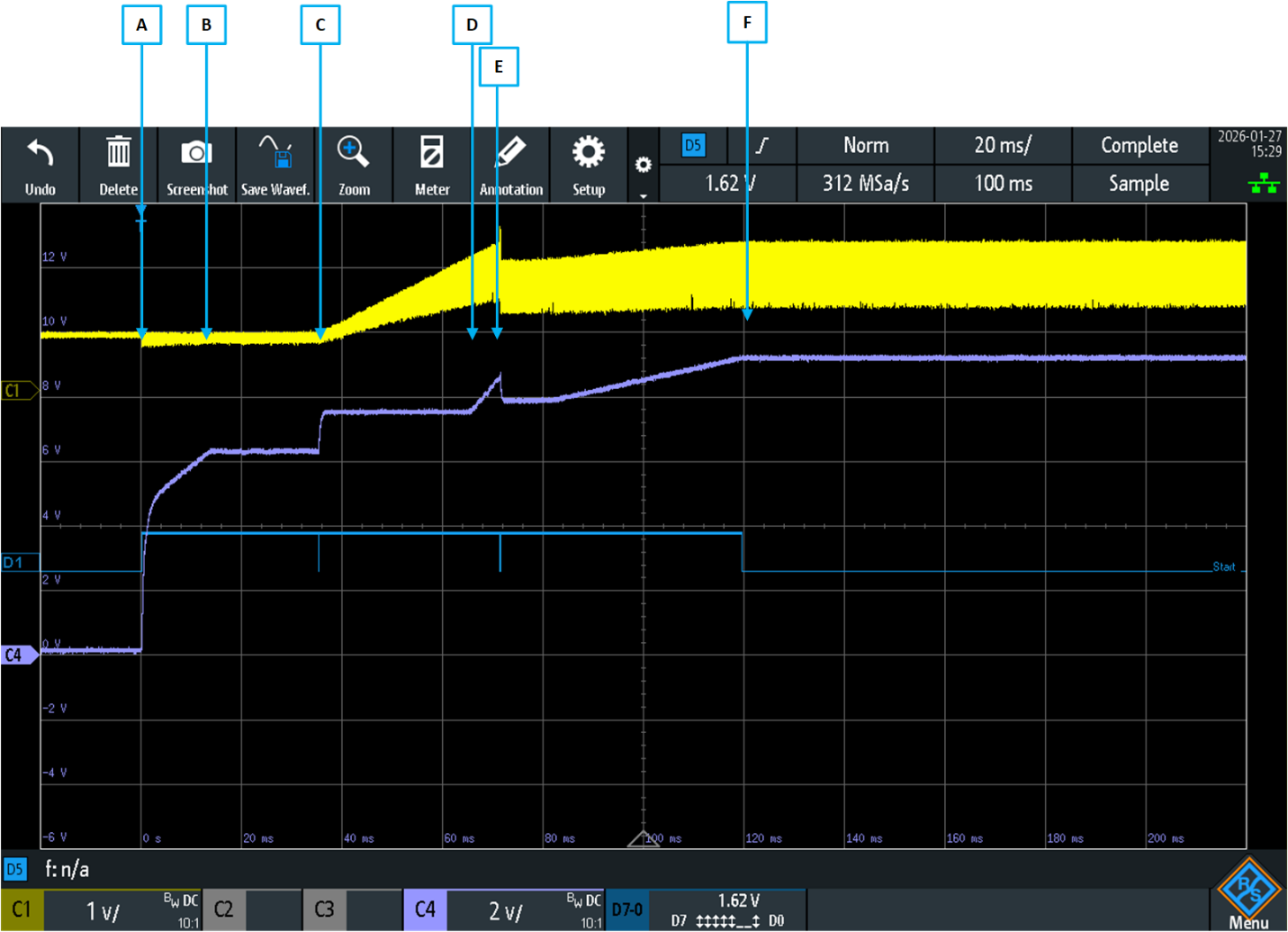
This sequence for start-up is illustrated in the scope plot in Figure 4-6. Here, Channel 4 is the output voltage, and Channel 1 is the DAC reference.
|
Ch. Name |
Signal |
|---|---|
C1 | DAC reference signal |
C4 | Output voltage |
D1 | Start event pin (toggles at events) |
A. The PWM is turned ON at 1.6 MHz.
B. Gradually increasing the PGPER register value leads to an increase in output voltage.
C. Beyond this point, further increases in the PGPER register do not result in higher output voltage, as the default DAC value, together with the leading-edge blanking (LEB) mechanism, constrains the pulse width and maintains a switching frequency of 1 MHz through capture events. At the end of the PGPER ramp-up, Secondary Rectifiers are turned on.
D. As the DAC reference is increased, the output voltage remains unchanged because the LEB mechanism continues to limit the frequency to 1 MHz.
E. The DAC is then increased further, bringing it within a range where the voltage loop can safely regulate the output. This step is essential, as abrupt changes in the DAC reference can cause large period jumps and result in excessive inrush currents.
F. Finally, the voltage control loop is enabled, a new output voltage reference of 9 V is applied, and the output voltage is gradually ramped up to the desired set point.
This methodical approach, as illustrated in the scope plot in Figure 4-6, ensures a reliable and stable start-up for the power supply, minimizing the risk of output overshoot, large inrush currents and instability.