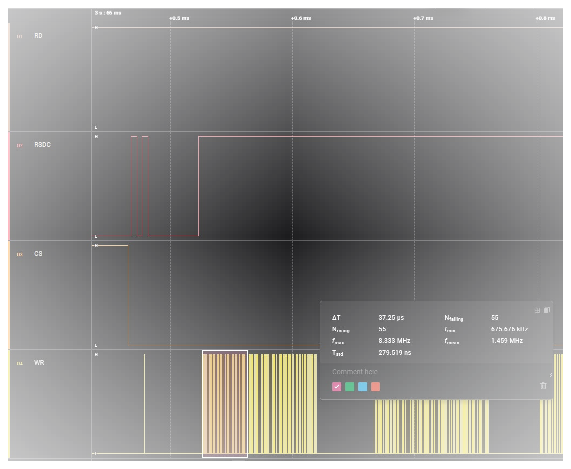
4.2 Bluetooth® Low Energy Parallel 8080 Timing
The timing operations for the external controller design are controlled within the external controller. The signals VSYNC, HSYNC, DEN, and PCLK are generated within the external controller. The PIC32CX-BZ6 interacts with the external controller using the parallel 8080 command signals Chip Select (CS), Read Data (RD), Write Enable (WE) , Register Select/Data Command (RSDC), RESET, and the eight data lines. For a full description of these signals, see the ILI9488 data sheet.
Instead of generating the timing signals directly, as seen in Bluetooth® Low Energy LCC, the MCU is responsible for transferring commands and data on the 8 data pins using the DMA and setting/clearing the parallel 8080 interface pins described above using GPIO. The Write Enable (WE) is generated in a similar fashion that the PCLK is generated in Bluetooth LE LCC. That is, a hardware timer generates events that trigger the DMA transfer. These events are transferred by the EVSYS to the CCL and the WR signal is generated. The WR signal tells the external controller when to latch the incoming data. The RSDC will determine if the incoming signal on the data lines are a command or data to be stored in the external controller.