
1.2 I2C Bootloader
The I2C bootloader Library can be used to upgrade firmware on a target device without the need for an external programmer or debugger.
Features
- Supported Only on Cortex-M0+ and Cortex-M4 based devices
- Uses Harmony 3 I2C PLIB to communicate resulting in smaller bootloader size
- Supports Fail Safe update
- Takes Binary File as input
- Receives Binary from an I2C Embedded Host Device
Running From SRAM (For SAM Devices)
- Has capability to self update as it
is running from SRAM
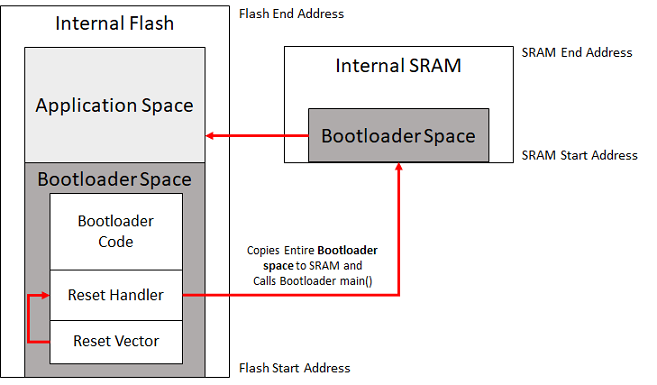
- At reset the bootloader Reset handler copies the entire bootloader firmware into SRAM from Start location and start executing from SRAM
- Once the application is called from bootloader, applications startup code takes control over SRAM and starts executing
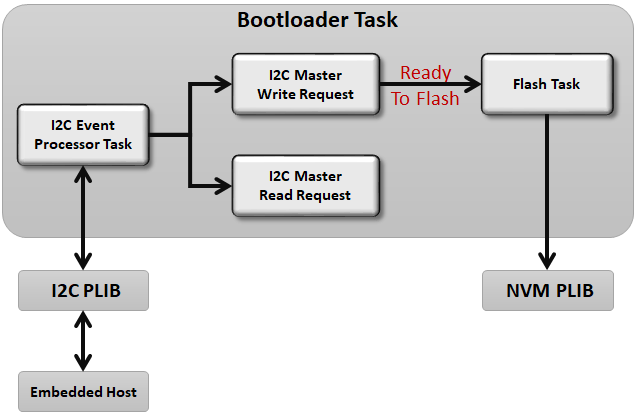
I2C Bootloader Block Diagram
-
I2C Event Processor Task:
-
This task is responsible for receiving data from Embedded Host through the I2C communication interface
-
The task polls and processes the I2C events
-
Based on the event received it gives control to I2C Host Write Request or I2C Host Read Request functions
-
This task is responsible for responding to the bootloader commands received
-
-
I2C Host Write Request:
-
This function is responsible to handle any write requests coming from I2C host
-
It processes the commands received and notifies the status to I2C Event Process Task
-
If the command received is a Erase/Program/Verify command it gives control to the Flash Task
-
-
I2C Host Read Request:
-
This function is responsible to handle any read requests coming from I2C host
-
It sends the current status to I2C host if the command received is Read Status
-
-
Flash Task:
-
This task is responsible to Erase/Program/Verify the internal Flash memory with data packet received
-
The task uses the NVM peripheral library to perform the Unlock/Erase/Write Operations
-