
9.1.3 Optimizing File Sizes
Integer Timestamps
Timestamps are formatted as float values by default. When floating point timestamps are logged during a longer running or high data rate capture, they take up a lot of disk space and are hard to compress. This results in large file sizes. Configuring the data logger to format timestamps as integers can result in smaller files.
To navigate to the timestamp configuration section, go to the log file configuration dialog:
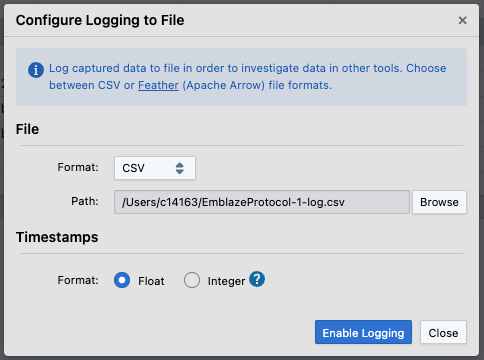
The default configuration values for Integer change when timestamp format
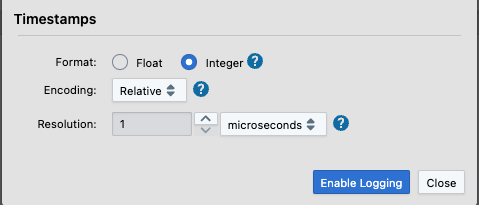
integer is first selected for a given data source or frame:
- Encoding: Relative
- Timestamps Resolution: 1
- Resolution Unites: Microseconds
These are the two resulting modes and their functionality:
- Relative: Each timestamp is converted to an integer and
calculated as an offset to the first timestamp in
the log file. Then, it is encoded according to the
timestamp resolution and units values. For example,
timestamp values of [33.000001, 33.000002,
33.000003] will be encoded as [0, 1, 2]
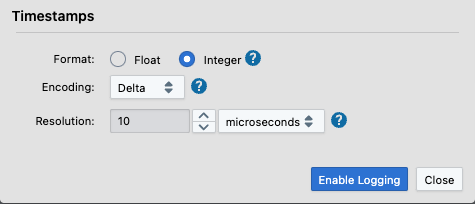
- Delta: Each timestamp is converted to an integer and
calculated as an offset to the previous timestamp in
the log file. Then, it is encoded according to the
timestamp resolution and units values. For example,
timestamp values of [33.000001, 33.000002,
33.000003] will be encoded as [0, 1, 1]
Integer Timestamp Decoding Example
This code example shows how to decode integer timestamps as floating
point values from a feather log:
import sys
import numpy as np
from pyarrow import feather as pf
import json

def read(filename):
  table = pf.read_table(filename)
  df = table.to_pandas()
  print(df)

  timestamps = df['timestamp']
  meta = json.loads(table.schema.metadata[b'data-visualizer'])
  timestamp_meta = meta['timestamp']
  format=timestamp_meta['format']
  if format == 'integer':
    encoding = timestamp_meta['encoding']
    factor = float(timestamp_meta['resolution'])
    if encoding == 'delta':
      timestamps = np.cumsum(timestamps)*factor
    elif encoding == 'relative':
      timestamps = np.multiply(timestamps, factor)

    print('decoded timestamps\n{}'.format(timestamps))

if __name__ == "__main__":
  if (len(sys.argv) < 2):
    print("Usage: decode_timestamps.py <file_name>")
    sys.exit(1)

  filename = sys.argv[1]
  print("Reading " + filename + " as pyarrow table")
  read(filename)