
1.3 Configuring the Library
This section provides details necessary to integrate the Class B library with other software components.
Reserved SRAM Area for the Class B Library
It is required to reserve 1kB of SRAM for exclusive use by the Class B library. When the Class B library is added into the project with the help of MCC, the linker setting is modified by MCC as shown below. In this example, the ATSAME54P20A device with 256kB of SRAM is used.
-DRAM_ORIGIN=0x20000400,-DRAM_LENGTH=0x3FC00
Modified Startup Sequence
When generating project with help of MPLAB Harmony 3, the startup code is present in
a file named startup_xc32. This file contains the
Reset_Handler which has all startup code that runs before the
main() function. Initialization of the Class B library is done
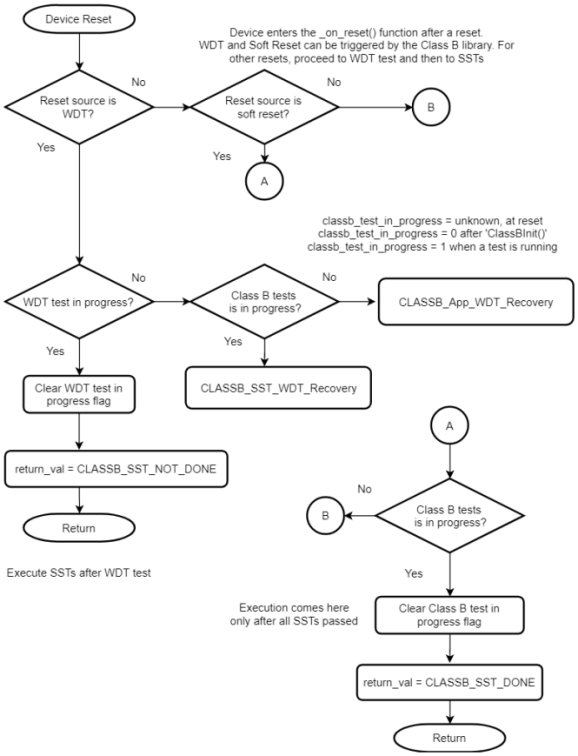
from the _on_reset function which is the first function to be
executed inside the Reset_Handler. The function named
CLASSB_Startup_Tests executes all startup self-tests inserted
into classb.c file by the MCC. If none of the self-tests are
failed, this function returns CLASSB_STARTUP_TEST_PASSED. If any of
the startup self-tests are failed, this function does not return. The self-tests for
SRAM, Clock and Interrupt are considered non-critical since it may be possible to
execute a fail-safe function after detecting a failure. In such case, the
CLASSB_SelfTest_FailSafe() function is called when a failure is
detected. In the case of critical failures (CPU registers or internal flash), the
corresponding self-test remains in an infinite loop to avoid unsafe execution of
code.
- The library defines the
_on_resetfunction and handles some of the reset causes. The application developer shall insert functions to handle the rest of the reset causes.
WDT Test and Timeout
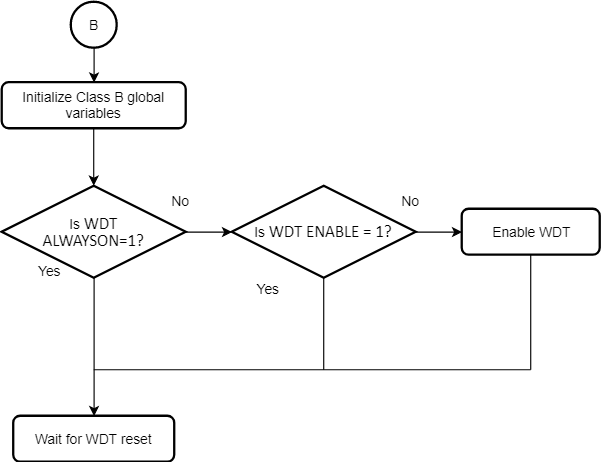
The Watchdog timer is used as a recovery mechanism in case of software failures. The
Class B library enables the WDT and checks whether a WDT reset is issued if the
timer is not cleared. In CLASSB_Startup_Tests, before performing
startup self-tests, the WDT timeout period is configured. This timing can be
adjusted based on the number of self-tests run during startup. If any of these
self-tests takes more time than the WDT timeout period, it results in a WDT reset.
Thus, properly configuring the WDT period is essential during startup. If all of the
self-tests pass during startup, then the Class B library startup resets the device.
When execution reaches the main() function, the WDT configuration will be same as
that in the fuses. So the WDT should be configured via fuses, as needed by the
application. The WDT timeout should be larger than the time taken by any of the
self-tests used during run-time.
Configuring Startup Tests via MCC
Use MHCM to clone the classb repo. When an MPLAB Harmony 3 project
is created, the MCC lists all available components that can be added to the project.
The self-tests which need to run during startup can be configured via MCC. The
Configuration Options menu appears with a mouse click on the
Class B Library component inside the Project
Graph. The configurations done via MCC does not configure the library,
instead it helps to modify the input arguments and to decide whether to run a
specific test during startup.