1.4.3.1 Bootloader Linker Configurations for Cortex-M Based MCUs
Linker configurations for the UART, I2C and CAN Bootloaders
-
Bootloader library uses a custom linker script which is generated through MCC
-
The values populated in the linker script are based on the Bootloader component MCC configurations
-
Bootloader is configured to run from RAM in this linker script to achieve simultaneous Flash memory write and reception of the next block of data.
Note: The below sections provides overview of changes done to bootloader linker scripts when compared to default linker script. The <bootloader_start> address and <bootloader_length> may vary based on the specific device used.
#define ROM_START <bootloader_start>

/* Bootloader size is calculated with below criteria with optimization level -O2
 * bootloader size = Minimum Flash Erase Size Or actual bootloader ELF size
                     (Rounded of to nearest erase boundary) whichever is
                     greater.
 */
#define ROM_SIZE  <bootloader_length>

/* Bootloader Trigger pattern needs to be stored in starting <trigger_len> Bytes
 * of Ram by the application if it wants to run bootloader at startup without any
 * external trigger.
 * Example:
 *     ram[0] = 0x5048434D;
 *     ram[1] = 0x5048434D;
 *     ....
 *     ram[n] = 0x5048434D;
 */
#define RAM_START (<ram_start> + <trigger_len>)

#define RAM_SIZE  (<ram_length> - trigger_len)

MEMORY
{
  rom (rx) : ORIGIN = ROM_START, LENGTH = ROM_SIZE
  ram (rwx) : ORIGIN = RAM_START, LENGTH = RAM_SIZE
}

SECTIONS
{
    /*
     * Configure to place the vector table in Flash but to be run from RAM
     */
    .vectors :
    {
        . = ALIGN(4);
        _sfixed = .;
        KEEP(*(.vectors .vectors.*))
    } > ram AT > rom

    .text :
    {
        . = ALIGN(4);
        ....
        ....
        . = ALIGN(4);
        _efixed = .;            /* End of text section */
    } > rom

    ....
    ....

    . = ALIGN(4);
    _etext = .;

    /* Locate text/rodata in special data section to be copied to RAM
       in startup sequence. */
    .data :
    {
        . = ALIGN(4);
        __data_start__ = .;
        _sdata = .;
        *(.dinit)
        *(.text)
        *(.text.*)
        *(.rodata)
        *(.rodata.*)
        . = ALIGN(4);
        __data_end__ = .;
        _edata = .;
    } > ram AT > rom

    ....
}
Custom startup file for UART, I2C and CAN Bootloaders
-
To reduce the size of the binary these bootloaders make use of custom startup file which is generated by MCC
-
This startup file places only the Reset handler in vector table instead of populating all the device vectors there by reducing the size of final .vector section
-
This startup file also copies the entire bootloader code placed in .data section above from Flash to RAM as it is built to run from RAM
/* Declaration of Reset handler (may be custom) */
void __attribute__((noinline)) Reset_Handler(void);

__attribute__ ((used, section(".vectors")))
void (* const vectors[])(void) =
{
  &_ram_end_,
  Reset_Handler,
};

...
...

/* Linker-defined symbols for data initialization. */
extern uint32_t _sdata, _edata, _etext;
extern uint32_t _sbss, _ebss;

void __attribute__((noinline, section(".romfunc.Reset_Handler"))) Reset_Handler(void)
{
    uint32_t *pSrc, *pDst;;

    pSrc = (uint32_t *) &_etext; /* flash functions start after .text */
    pDst = (uint32_t *) &_sdata;  /* boundaries of .data area to init */

    /* Copy code from flash to RAM using .data section */
    while (pDst < &_edata)
        *pDst++ = *pSrc++;

    /* Init .bss */
    pDst = &_sbss;
    while (pDst < &_ebss)
      *pDst++ = 0;

....
....
}
MPLAB X Setting for UART, I2C and CAN Bootloaders
-
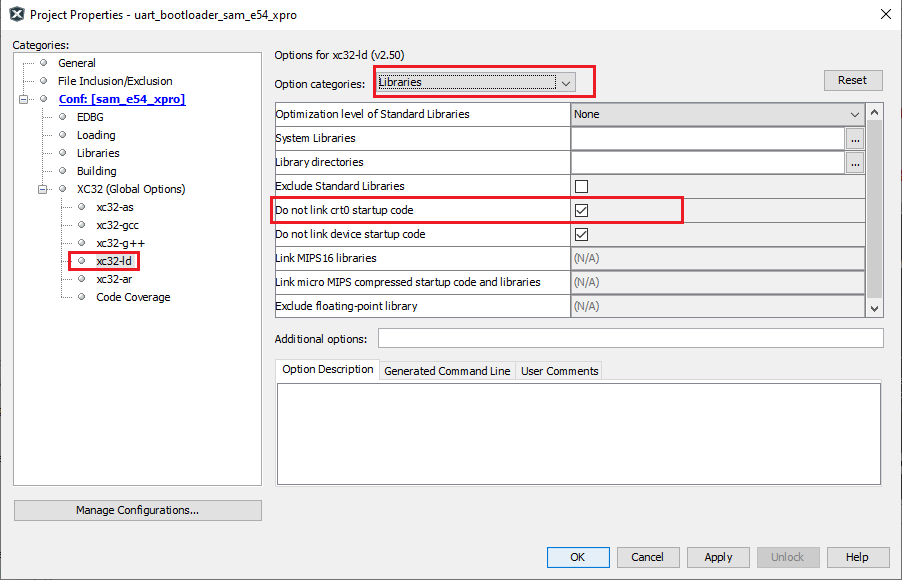
Below MPLAB X option is enabled by MCC for these bootloaders to remove the XC32 crt0 startup code
-
By disabling this crt0 startup code, further reduce the size as it removes the default initialization mechanism code by XC32