2.2 DC Regulation Enhancements
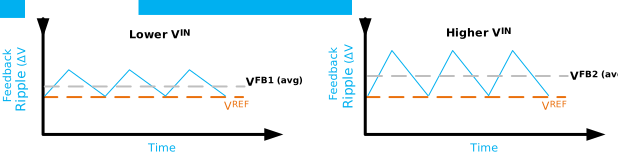
Basic COT control regulates the valley of the feedback ripple, which leads to poor line regulation due to the dependency of the feedback ripple amplitude on the input voltage. The deviation of the average feedback voltage in response to input voltage variations is illustrated in Figure 2-2. VFB1(avg) represents the average feedback voltage for a lower input voltage, while VFB2(avg) represents the average feedback voltage for a higher input voltage.
Microchip has incorporated special blocks in ACOT to directly regulate the average feedback voltage instead of regulating the valley of the feedback ripple. The DC regulation enhancement block is a significant addition to Microchip's ACOT control, effectively eliminating the inherent line regulation issues of basic COT control.
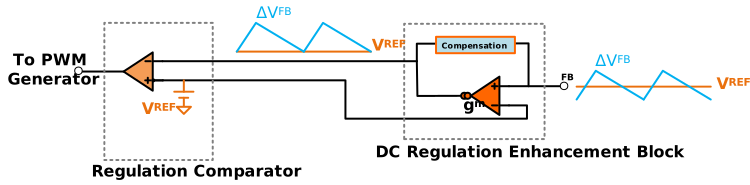
Figure 2-3 illustrates the interaction of the DC regulation enhancement block and main regulation comparator with waveforms (before and after the DC regulation enhancement block).
The DC regulation enhancement block consists mainly of an operational transconductance amplifier (gm) and a discrete compensation circuit. Its key functions include forwarding all the AC ripple and providing gain for the DC component. As shown in Figure 2-1 and Figure 2-3, the DC regulation enhancement block is placed prior to regulation comparator in the feedback network. This arrangement ensures that the output voltage is regulated to the average of the feedback ripple, thereby improving DC regulation in ACOT.