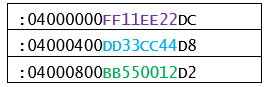
The binary stream of bits for above memory file data is:
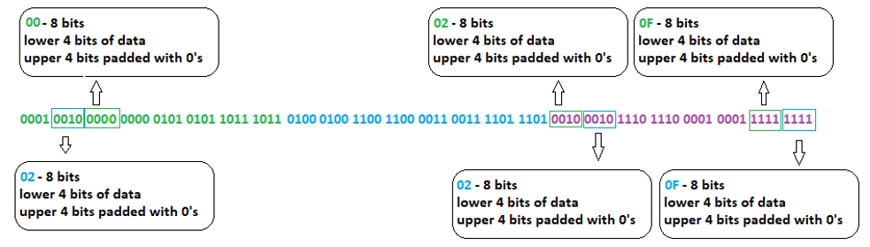
If the memory port width is 4 bits, the tool reads 8 bits at a time from the binary
stream above. For the 8 bits, you must pad zeros for the upper 4 bits and specify the
actual data in the lower 4 bits, as shown in the following figure.Figure 4-11. Padding Zeros for the Upper 4
Bits and Specifying Data in the Lower 4 Bits
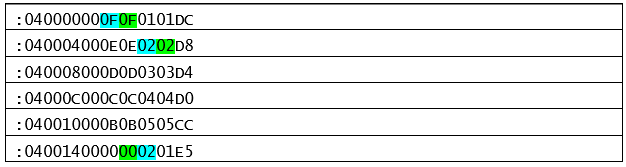
The following figure shows the equivalent memory file data padded with zeros to achieve a
4-bit write port width.
Figure 4-12. Equivalent Memory File Data Padded
with Zeros (4-bit Write Port Width)
When the tool parses the above memory file data (padded with zeros), it converts the data
to binary and reads it as a stream of bits. If the port width is 4 bits, the tool reads
8 bits (byte-aligned), ignores the upper 4 bits of actual data, and stores the lower 4
bits of actual data in RAM, as listed in the following table.
Table 4-2. 16-bit Write Port Width
Address
Data
0
0xF
1
0xF
2
0x1
3
0x1
4
0xE
5
0xE
6
0x2
7
0x2
8
0xD
9
0xD
A
0x3
B
0x3
C
0xC
D
0xC
E
0x4
F
0x4
10
0xB
11
0xB
12
0x5
13
0x5
14
0x0
15
0x0
16
0x2
17
0x1
Note: x1 and x2 port widths are handled
using the same technique of padding zeros. You always zero pad to the next
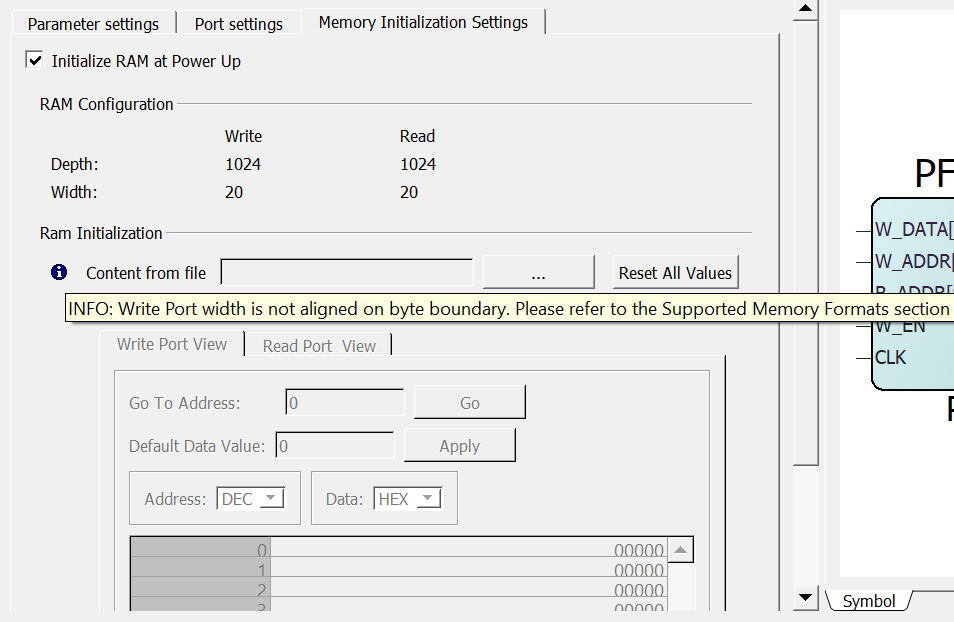
8-bit-width increment (8, 16, 24, and so on). If a write port width is not aligned
on a byte boundary, the following message appears. Figure 4-13. Message when a Write Port Width is Not Aligned on a Byte Boundary
The online versions of the documents are provided as a courtesy. Verify all content and data in the device’s PDF documentation found on the device product page.