
2 Important Considerations Before You Start
2.1 Initial Decisions
This chapter provides essential information that should be reviewed carefully before proceeding. It outlines critical decisions that must be made prior to integrating the Nano Debugger into a design. Specifically, it addresses two key considerations:
- The type of hardware you plan to develop.
- The type(s) of target devices you intend to use.
2.2 What Kind of Hardware Are You Developing
Refer to the decision flowchart provided to identify the type of hardware you plan to develop. This will guide you to the appropriate section for further information.
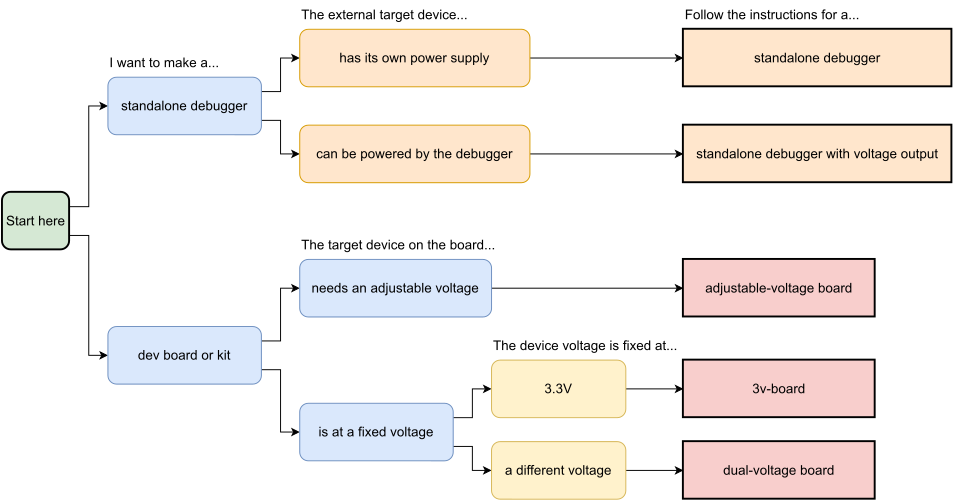
After making your decision, review the corresponding section below to ensure your selection aligns with the provided descriptions.
| Is the Target Device Mounted? | Is the Target Device Powered by the Nano Debugger hardware? | Does the Target Device Run at 3.3 V Only? | |
|---|---|---|---|
| Standalone Debugger | No | No | No |
| Standalone Debugger with target supply | No | Possibly | No |
| Adjustable-voltage board | Yes | Yes | No |
| 3.3V board | Yes | Yes | Yes |
| Fixed-voltage level-shifted board | Yes | Yes | No |
Standalone Debugger
This type of board does not include a target device. Instead, a connector is installed to allow users to connect to a target device located on a separate board. For standalone debugger applications, level shifters are necessary to ensure both convenience and electrical protection, as the target board may operate at various voltages. The Nano Debugger monitors the target voltage but does not control it; the voltage must be supplied by the external board.
Making a Fixed-Voltage Level-Shifted Board will guide you toward achieving your objective.
Standalone Debugger With Target Supply
This type of board does not include a target device. A connector must be installed to allow users to connect to a target device located on a separate board. For standalone debugger applications, level shifters are required to ensure convenience and electrical protection, as the target board may operate at different voltages. In this configuration, the Nano Debugger can supply a voltage to the target device.
Making a Standalone Debugger with Target Supply will guide you toward achieving your objective.
Adjustable-Voltage Board
This configuration refers to a development board with a permanently mounted target device. The target device operates at an adjustable voltage, which is managed by the Nano Debugger and powered by USB VBUS. Because the Nano Debugger operates at 3.3V, level shifting is required between the debugger and the target device to ensure proper operation and compatibility.
All Curiosity Nano MCU boards are examples of this type of configuration.
Making an Adjustable-voltage Board will guide you toward achieving your objective.
3.3V Board
This configuration describes a development board with a permanently mounted target device. The target device is powered by the same fixed 3.3V regulator as the Nano Debugger, eliminating the need for level shifting between the two components.
Making a 3.3V Board will guide you toward achieving your objective.
Fixed-Voltage Level-Shifted Board
This configuration refers to a development board with a permanently mounted target device, where the target device or other peripheral circuits require operation at a voltage different from 3.3V. Since the Nano Debugger operates at 3.3V, level shifting is necessary between the debugger and the target device. The Nano Debugger does not control the alternate voltage domain; it must be provided by an appropriate external source.
Making a Fixed-Voltage Level-Shifted Board will guide you toward achieving your objective.
This document provides detailed information on each scenario individually. Select the scenario that applies to your design before proceeding.
If your intended use of the Nano Debugger does not fit any of the scenarios described, return to the starting point in the decision chart or contact Microchip Support for further assistance. You may also reach out via email at edbg@microchip.com.
2.3 Target Device Types
The Nano Debugger debugging interfaces support the following device types:
- All Arm Cortex-M devices with an SWD interface that are supported by a CMSIS-DAP compliant IDE, MPLAB for VS Code, or MPLAB X IDE.
- All AVR devices with a UPDI programming and debugging interface that are supported in MPLAB for VS Code, MPLAB X IDE, Microchip Studio, or partner IDEs compatible with EDBG-based Tools Protocols.
- Any PIC16, PIC18, PIC24, or dsPIC33 device that is available with a Curiosity Nano kit.
Drag-and-drop programming enables users to program the target device’s flash memory by simply dragging a HEX or UF2 file onto the Curiosity Nano’s Mass Storage disk. This feature is supported only for AVR and PIC16/PIC18 devices and is not available in standalone debugger configurations.
Select one or more of these categories to proceed.
If you plan to use the Nano Debugger with a device that does not fit into any of these three categories, contact Microchip Support for further assistance (or email: edbg@microchip.com).