
1.3 Selecting the Appropriate Device
Selecting the appropriate LAN9645x configuration depends on the required feature set and level of system management. The LAN9645x family can be viewed as a four-tier solution, ranging from fully managed to fully unmanaged operation.
Below is a shortened Decision Guide based on the LAN9645x - Choosing the Correct Switch for your Application Knowledge Base Article referenced in Documentation.
Decision Guide
Use the following hierarchy to select the appropriate device and configuration:
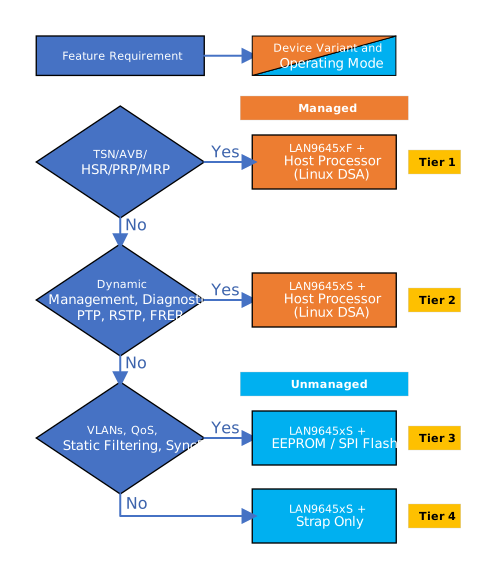
Tier 1 – Full Feature Managed (Highest Capability)
LAN9645xF + External Host (Linux DSA)
Use this configuration if your application requires:
- TSN / AVB features (TAS, CQF, frame preemption, shaping)
- High-availability redundancy (HSR, PRP)
- Advanced traffic control and deterministic networking
Requirements:
- External Linux-capable host processor
- SPI (control plane via Linux DSA)
- Network Processor Interface (data interface)
Tier 2 – Standard Managed
LAN9645xS + External Host (Linux DSA)
Use this configuration if you need:
- Dynamic configuration and monitoring
- PTP (events, clocks, synchronization)
- FRER
- MRP / RSTP and other managed features
- QoS control, MAC table updates, diagnostics
Requirements:
- External Linux-capable host processor
- SPI (control plane via Linux DSA)
- Network Processor Interface (data interface)
Tier 3 – Unmanaged with EEPROM / SPI Flash (Static Configuration)
LAN9645xS + External EEPROM / SPI Flash
Use this configuration if your design requires:
- Fixed VLANs, QoS, and traffic shaping
- Static port configuration and PHY initialization
- Features such as SyncE, and filtering, preconfigured at boot
Requirements:
- EEPROM module (I2C table) or SPI Flash module (SPI table)
- Configuration is generated using the LAN9645x EEPROM GUI Configurator Tool
- Loaded automatically at startup (no host required)
Tier 4 – Unmanaged (Strap-Only, Lowest Complexity)
LAN9645xS (No EEPROM / SPI Flash, Strap Configuration)
Use this configuration for:
- Basic Layer 2 switching
- Simple port connectivity and bring-up
- Minimal configuration, lowest cost and complexity
Limitations:
- No dynamic or advanced feature control
- Only basic functionality enabled via hardware straps
Summary
- Use LAN9645xF (Tier 1) for TSN, AVB, or high-availability networking
- Use LAN9645xS + host (Tier 2) for managed switching without TSN or high-availability redundancy
- Use LAN9645xS + EEPROM / SPI Flash (Tier 3) for static, preconfigured systems
- Use LAN9645xS strap-only (Tier 4) for simple unmanaged designs