
1.1.9 PIC32MZ Embedded Graphics With Stacked DRAM (DA) Starter Kit (Crypto): Building and Running the UART Bootloader Applications
Downloading and Building the Application
To clone or download this application from Github, go to the main page of this repository and then click Clone button to clone this repo or download as zip file. This content can also be download using content manager by following these instructions.
Path of the application within the repository is apps/uart_bootloader/.
To build the application, refer to the following table and open the project using its IDE.
Bootloader Application
| Project Name | Description |
|---|---|
| bootloader/firmware/pic32mz_das_sk.X | MPLAB X Project for PIC32MZ Embedded Graphics With Stacked DRAM (DA) Starter Kit (Crypto) |
Test Application
| Project Name | Description |
|---|---|
| test_app/firmware/pic32mz_das_sk.X | MPLAB X Project for PIC32MZ Embedded Graphics With Stacked DRAM (DA) Starter Kit (Crypto) |
Setting Up PIC32MZ Embedded Graphics With Stacked DRAM (DA) Starter Kit (Crypto)
- Connect a micro USB cable to the UART-USB port J5
- For programming, connect a micro USB cable to the USB Debug port J19
Setting Up the Host Script
- Refer to the Bootloader Host Script Help for setting up the btl_host.py utility used to send the application binary from host PC
Running the Application
-
Open the test application project test_app/firmware/pic32mz_das_sk.X in the IDE.
-
Build the project to generate the binary (Do not program the binary).
-
Open the bootloader project bootloader/firmware/pic32mz_das_sk.X in the IDE.
-
Build and program the application using the IDE.
-
Run the btl_host.py from command prompt to program the application binary.
python <harmony3_path>/bootloader/tools/btl_host.py -v -i <COM PORT> -d pic32mz -a 0x9D000000 -f <harmony3_path>/bootloader_apps_uart/apps/uart_bootloader/test_app/firmware/pic32mz_das_sk.X/dist/pic32mz_das_sk/production/pic32mz_das_sk.X.production.bin -
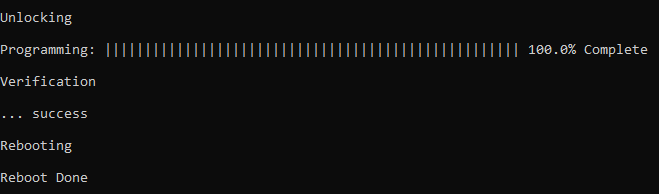
Following figure shows output of successfully programming the test application.
- Rebooting and Reboot Done messages in below output signifies that bootloading is successful
-
If above step is successful then the LED3 should start blinking.
-
Open the Terminal application (e.g., Tera Term) on the computer.
-
Configure the serial port settings as follows:
- Baud: 115200
- Data: 8 Bits
- Parity: None
- Stop: 1 Bit
- Flow Control: None
-
Reset or Power cycle the device.
-
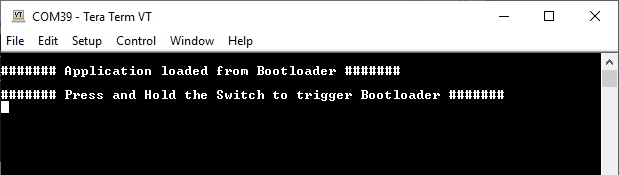
LED3 should start blinking and the user should see below output on the console.
-
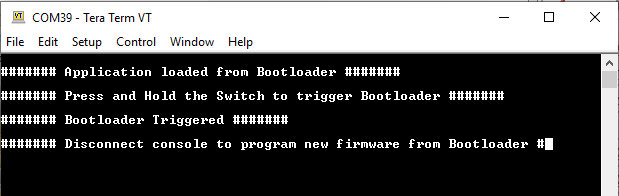
Press and hold the Switch SW1 to trigger Bootloader from test application and the user should see below output.
-
Repeat Steps 5-11 once and jump to Step 14.
- This step is to verify that bootloader is running after triggering bootloader from test application in Step 12
-
Press and hold the Switch SW1 and then Power cycle the device to force trigger bootloader at startup.
-
Repeat Steps 5-11 once.
- This step is to verify whether bootloader is triggered by switch press at reset
Additional Steps (Optional)
- To bootload any other application, refer to the Configuring an Application to Be Bootloaded for MIPS Based MCUs