2.2.4 I2C Master Mode Repeated Start Condition Timing
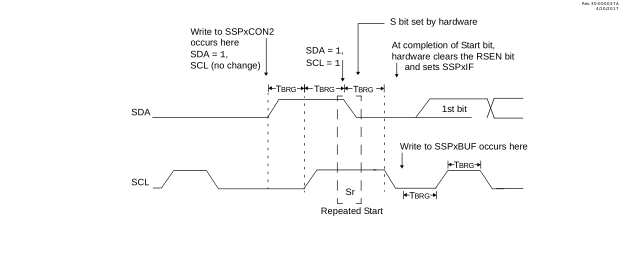
A Repeated Start condition (see Figure 2-6) occurs when the Repeated Start Condition
Enable (RSEN) bit is programmed high and the master state machine is no longer
active. When the RSEN bit is set, the SCL pin is asserted low. When the SCL pin is
sampled low, the Baud Rate Generator is loaded and begins counting. The SDA pin is
released (brought high) for one Baud Rate Generator count (TBRG). When
the Baud Rate Generator times out, if SDA is sampled high, the SCL pin will be
deasserted (brought high). When SCL is sampled high, the Baud Rate Generator is
reloaded and begins counting. SDA and SCL must be sampled high for one
TBRG. This action is then followed by assertion of the SDA pin
(SDA = 0) for one TBRG, while
SCL is high. After the BRG sample time has passed, SCL is asserted low. Following
this, the RSEN bit will be automatically cleared and the Baud Rate Generator will
not be reloaded, leaving the SDA pin held low. As soon as a Start condition is
detected on the SDA and SCL pins, the S bit will be set. The SSPxIF bit will not
be set until the Baud Rate Generator has timed out.
- If RSEN is programmed while any other event is in progress, it will not take effect.
- A bus collision during the Repeated Start
condition occurs if:
- SDA is sampled low when SCL goes from low-to-high.
- SCL goes low before SDA is asserted
low. This may indicate that another master is attempting
to transmit a data ‘
1’.