
4.3.1 Dual-Band Transceiver with Two Antennas
For bidirectional applications requiring two receive frequencies, see Figure 4-10. Each RF band has its own antenna, connected directly to the corresponding LNA. The signal from RF_OUT is switched via the internal SPDT to ensure proper load impedance for each frequency band, connecting directly to the corresponding antenna path.
The following figure illustrates a dual-band transceiver configuration where low-band and high-band inputs, RFIN_LB and RFIN_HB, and the RF output are each connected to their own antenna with switching as required (RFIN_LB + RFIN_HB + RF_OUT + 2 x ANT).
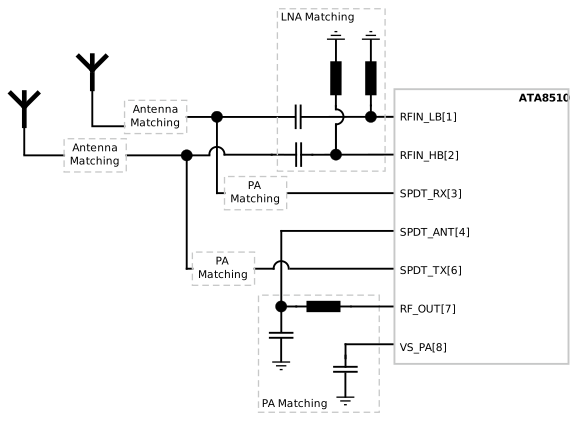
Matching in this scenario is straightforward, as each circuit part can be investigated separately. The user can implement SPDT control as explained in previous chapters. For more details, see Figure 4-3. For optimal performance in Receive (RX) mode, the user must pay special attention to SPDT settings. In case of using same services for RX and Transmit (TX), the SPDT switches to the current frequency path in RX mode, resulting in a low-resistance path that can lower receiver sensitivity. To avoid this, disable the SPDT in RX mode via the Front-end register configuration after starting the RX mode. Alternatively, use separate services for RX and TX modes, configuring the SPDT in the RX mode to the opposite position used in TX mode. This creates a high-resistance path, preserving receive signal strength.