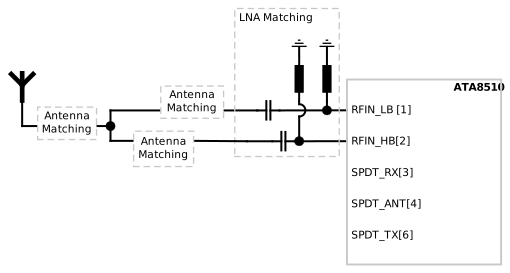
4.1.2 Dual-Band Receiver with Single Antenna
When only one antenna serves both frequency bands, use the built-in SPDT to combine the two RF input pins. Perform LNA matching individually for each frequency band, but pay special attention to the antenna. Use either a broadband antenna or tune the antenna for both frequencies. This tuning can occur within the switched path, allowing both LNA matching and antenna transformation.
The following figure illustrates a dual-band receiver configuration where low-band and high-band inputs, RFIN_LB and RFIN_HB, share a single antenna through the internal SPDT switch (RFIN_LB + RFIN_HB + 1 x ANT).

In this use case, match each single block straightforwardly. Ensure that the LNA and SPDT are activated and switched to the right position for the matching investigation. Enable the used and correctly configured service to do this.
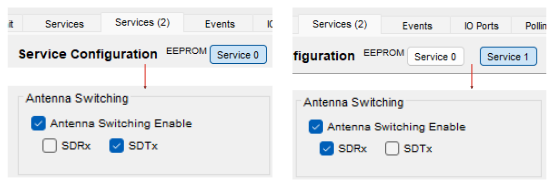
This example also works without the SPDT. Connect both LNAs, turning OFF the unused one so it becomes a high-impedance path. In this scenario, matching requires more effort, as parasitic influences from the unused path must be considered.
The following figure illustrates a dual-band receiver setup where low-band and high-band inputs, RFIN_LB and RFIN_HB, are directly connected to a single antenna without using the SPDT (RFIN_LB + RFIN_HB + 1 x ANT).