
4 Audio Class D Amplifier (CLASSD)
The Audio Class D Amplifier (CLASSD) is a digital input, Pulse Width Modulated (PWM) output stereo Class D amplifier. It features a high-quality interpolation filter embedding a digitally controlled gain, an equalizer and a de-emphasis filter.
The CLASSD takes 16-bit signed data with the most common audio sample rates at its input and generates PWM output that can drive either:
- High-impedance single-ended or differential output loads (Audio DAC application), or
- External MOSFETs through an integrated non-overlapping circuit (Class D power amplifier application)
The DSP section of the CLASSD has been designed to run at two clock frequencies (DSPCLK - 12.288 MHz and 11.289 MHz) and supports input sampling rates as listed below:
8 kHz, 16 kHz, 22.05 kHz, 32 kHz, 44.1 kHz, 48 kHz, 88.2 kHz and 96 kHz.
The CLASSD peripheral has an internal fixed divide-by-8 prescaler before the DSP section, so the generic clock frequency from the power manager (PMC) to the CLASSD should be 8 times the desired DSP clock. For example, if DSPCLK is 12.288 MHz, the GCLK should be (12.288 MHz * 8) = 98.304 MHz. The Audio PLL has to be configured to generate the GCLK clock accordingly.
The following figure shows the CLASSD amplifier block diagram.
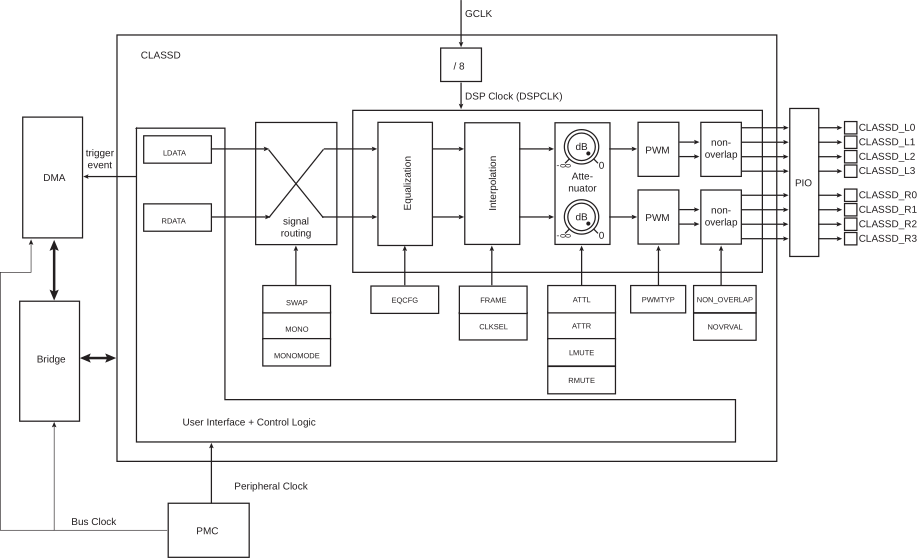
The CLASSD has an interpolator, an equalizer, a de-emphasis filter, an attenuator and a PWM stage. The following sections give a brief description of each DSP component. Refer to the SAMA5D2 data sheet section "Audio Class D Amplifier (CLASSD)" for more descriptive information about each DSP component of the CLASSD module.