
3.2.1.2 Skew Matching
(Ask a Question)The length of differential lanes must be matched within the TX and RX group. This applies only to specific protocols such as XAUI.
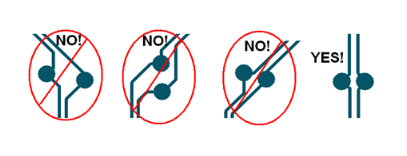
Differential pairs must be routed symmetrically in-to and out of structures, as shown in Figure 3-3.
The following figure shows the skew matching.
Skin effect dominates as the speed increases. To reduce the skin effect, the width of the trace must be increased (loosely coupled differential traces). Increase in trace width causes increase in dielectric losses. To minimize dielectric loss, use low Dissipation Factor (DF) PCB materials such as Nelco 4000-13EP SI. Cost is significantly higher than FR4 PCB material, but FR4 PCB material cannot provide increased eye-opening when longer trace interconnections are required. Ensure that a 85–100 Ω differential impedance is maintained. This is an important guideline to be followed if the data rate is 5 Gbps or higher.
Far end crosstalk is eliminated by using stripline routing. However, this type of routing in stripline causes more dielectric loss. In order to minimize dielectric loss, it is better to route as a microstrip if there is enough space between differential pairs (>4 times the width of the conductor). Simulations are recommended to see the best possible routing.
Instruct the fabrication vendor to use these PCB materials before manufacturing.
Transceiver traces must be kept away from the aggressive nets or clock traces. For example, on MPF300 devices, the transceiver and DDR traces must not be adjacent to each other. Trace stubs must be avoided.
It is recommended to use low roughness, that is, smooth copper. As the speed increases, insertion loss due to the copper roughness increases. The attenuation due to skin effect is increased proportional to the square root of frequency. Microchip recommends instructing the PCB fabrication house to use smooth copper, if the frequency exceeds 2 Gbps.
Split reference planes must be avoided. Ground planes must be used for reference for all transceiver lanes.
