3.2.1.3 Via
(Ask a Question)The target impedance of vias are designed by adjusting the pad clearance (anti-pad size). Field solver must be used to optimize the via according to the stack-up.
Follow these guidelines:
- Many vias on different traces must be avoided, or minimized as much as possible.
- The length of via stubs must be minimized by back-drilling the vias, routing signals from the near-top to the near-bottom layer, or using blind or buried vias. Using blind-vias and back drilling are good methods to eliminate via stubs and reduce reflections.
- If feasible, non-functional pads must be removed. Non-functional pads on-via are the pads where no trace is connected. This reduces the via capacitance and stub effect of pads.
Using tight via-to-via pitches helps reducing the effect of crosstalk, as shown in the following figure.
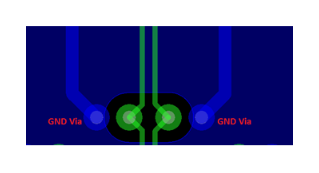
Symmetrical ground vias (return vias) must be used to reduce discontinuity for Common mode signal components, as shown in the following figure. Common mode of part of the signal requires continuous return path for TX and RX to GND. Return vias help maintain the continuity.