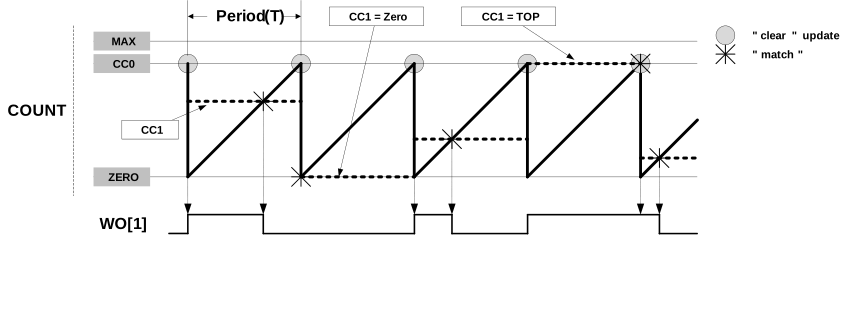
22.4.2.5.1 Waveform Output Operations
- Choose a waveform generation mode using the Waveform Generation Mode bit field in the Waveform Generation Control register (WAVE.WAVEGEN).
- Optionally invert the waveform output WO[n] by setting the corresponding Waveform Output n Invert Enable bit in the Driver Control register (DRVCTRL.INVENn).
- Configure the pins as output using the I/O Pin Controller. Refer to the I/O Pin Controller (PORT) section for details.
The counter value is continuously compared with each CC[n] value. On a comparison match, the Match or Capture Channel n bit in the Interrupt Flag Status and Clear register (INTFLAG.MCn) will be set (see Normal Frequency Operation). An interrupt and/or event can be generated on comparison match if enabled. The same condition also generates a DMA request.
- Normal frequency (NFRQ)
- Match frequency (MFRQ)
- Normal pulse-width modulation (NPWM)
- Match pulse-width modulation (MPWM)
When using NPWM or NFRQ configuration, the TOP value is determined by the counter resolution. In 8-bit Counter mode, the Period register (PER) is used as TOP, and the TOP can be changed by writing to the PER register. In 16- and 32-bit Counter mode, TOP is fixed to the maximum (MAX) value of the counter.
The table below shows the update counter and overflow event/interrupt generation conditions in different operation modes.
| Name | Operation | TOP | Update | Output Waveform | OVF Interrupt/Event | ||
|---|---|---|---|---|---|---|---|
| On Match | On Update | Up | Down | ||||
| NFRQ | Normal Frequency | PER | TOP/ ZERO | Toggle | Stable | TOP | ZERO |
| MFRQ | Match Frequency | CC[0] | TOP/ ZERO | Toggle | Stable | TOP | ZERO |
| NPWM | Normal PWM | PER | TOP/ ZERO | See description below | TOP | ZERO | |
| MPWM | Match PWM | CC[0] | TOP/ ZERO | See description below | TOP | ZERO | |
For Normal Frequency Generation, the period time (T) is controlled by the TOP value. The waveform output (WO[n]) is toggled on each compare match between COUNT and CC[n], and the corresponding Match or Capture Channel n Interrupt Flag (INTFLAG.MCn) will be set.
For Match Frequency Generation, the period time (T) is controlled by the CC[0] register instead of TOP. WO[0] toggles on each update condition.
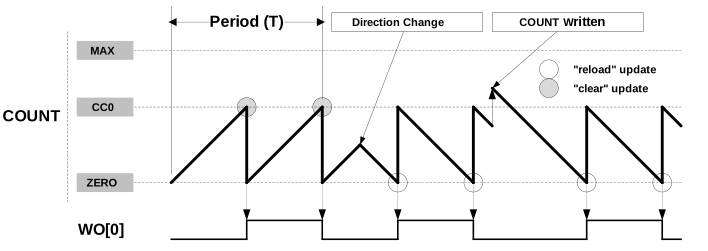
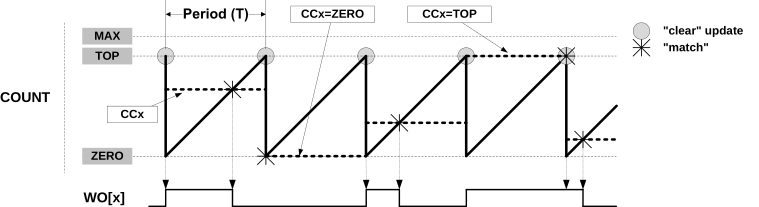
NPWM uses single-slope PWM generation.
For single-slope PWM generation, the period time (T) is controlled by the TOP value, and the CC[n] controls the duty cycle of the generated waveform output. When counting upwards, WO[n] is set at the start or on compare match between the COUNT and TOP values, and cleared on a compare match between COUNT and CC[n] register values. When counting downwards, the WO[n] is cleared at the start or on a compare match between the COUNT and ZERO values, and set on compare match between COUNT and the CC[n] register value.
The following equation calculates the exact resolution in bits for a single-slope PWM (RPWM_SS) waveform:
The PWM frequency (fPWM_SS) depends on the TOP value and the peripheral clock frequency (fGCLK_TC), and can be calculated by the following equation:
Where N represents the prescaler divider used (1, 2, 4, 8, 16, 64, 256, 1024).
In MPWM mode, the output of WO[1] depends on CC1 as shown in the figure below. On every overflow or underflow, a one-TC-clock-cycle negative pulse is output on WO[0] (not shown in the figure).