4.7.1 MII or SC-MII: Clock Source Applied to Crystal Pins (XTI/XTO)
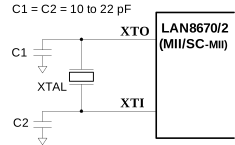
When using MII or SC-MII, most applications will connect a 25.0 MHz crystal to the XTI and XTO pins. Figure 4-4 depicts these pins and the external components required. The crystal should be in a fundamental, parallel resonant mode, with a frequency of 25.0 MHz.. Since the internal inverter/amplifier is operated in its linear region, external series resistors should not be used as they will lower the gain and could cause start-up problems. The device contains an internal ~1 MΩ resistance in parallel with the crystal amplifier to initiate oscillation, therefore an external resistance between XTO and XTI should not be used. Several factors must be considered when selecting a crystal including load capacitance, oscillator margin, cut, and operating temperature. Detailed specifications for the crystal can be found in the Crystal Specifications section and additional information be found in the Crystal Oscillator Selection section.