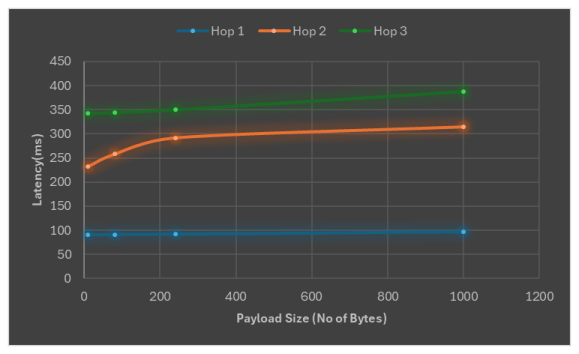
4.3 Latency
-
The latency test measures the time required for a packet to travel from the source node to the destination node in the Thread network. It indicates how quickly the network can deliver data and is an important metric for evaluating responsiveness, especially in real-time or control applications.
-
Latency increases with payload size because larger packets require more time for over-the-air transmission and processing at each node. In a Thread network, larger payloads can result in longer airtime, a greater likelihood of fragmentation, and additional processing at intermediate Routers. Together, these factors increase end-to-end delay.
-
The test was performed under both single-hop and multi-hop scenarios. In the single-hop scenario, the packet travels directly from the source to the destination, representing the minimum achievable latency for the network. In the multi-hop scenario, the packet passes through one or more intermediate Routers, introducing additional processing and forwarding delays. Comparing these scenarios helps show how routing and network topology affect packet delivery time.
-
Latency measurements were performed using packet payload sizes of 10 bytes, 80 bytes, 240 bytes, and 1000 bytes.
-
Testing with these payload sizes enables evaluation of both non-fragmented and fragmented transmissions, providing insight into how packet size and fragmentation affect end-to-end delay. This helps assess network responsiveness under varying traffic conditions and payload sizes.
| Payload Size (Bytes) | Hop 1 Latency (ms) | Hop 2 Latency (ms) | Hop 3 Latency (ms) |
|---|---|---|---|
| 10 | 90.06 | 232.61 | 342.5 |
| 80 | 90.84 | 257.87 | 343.93 |
| 240 | 91.68 | 291.59 | 349.74 |
| 1000 | 97.11 | 314.14 | 387.18 |