4.4 Packet Error Rate (PER)
-
The Packet Error Rate (PER) test was conducted to evaluate the reliability and performance of the Thread network under different communication scenarios and payload conditions.
-
The evaluation was performed in both single-hop and multi-hop topologies to analyze packet delivery over a single link and across multiple routing nodes.
-
To assess the effect of payload size on network reliability, PER testing used UDP packet payload sizes of 10 bytes, 80 bytes, 240 bytes, and 1000 bytes.
-
The test scenario evaluates network performance using both small, non-fragmented packets for direct transmissions and larger packets that require fragmentation and reassembly at the network layer.
-
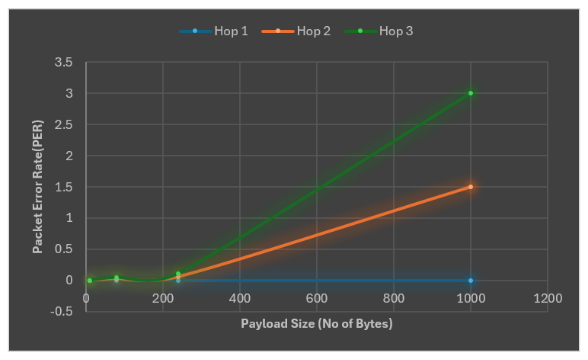
Testing across these packet sizes helps show how payload size influences packet-loss characteristics. Larger payloads generally have a higher probability of packet loss because of longer transmission time, greater susceptibility to interference, and the added overhead associated with fragmentation.
-
As the number of hops increases, each intermediate transmission introduces an additional opportunity for errors caused by channel conditions, interference, and noise. The cumulative effect of multiple hops increases the likelihood of packet loss, resulting in a higher PER.
Packet Error Rate (PER) – Single-Hop
In the single-hop scenario, the transmitting node and receiving node are within direct communication range, and packets are delivered over a single wireless link without passing through intermediate Routers. This setup measures baseline network performance by minimizing routing overhead and eliminating the effects of intermediate nodes. The PER measured in this configuration reflects raw link quality and the efficiency of the underlying IEEE 802.15.4 wireless communication used by the Thread protocol stack.
Packet Error Rate (PER) – Multi-Hop
In the multi-hop scenario, packets are transmitted from the source node to the destination node through one or more intermediate Thread Routers. Each Router receives the packet and forwards it to the next node in the path until it reaches the final destination. This setup represents a more realistic deployment scenario for large mesh networks, where devices may not be within direct radio range of one another. Multi-hop communication introduces additional factors, such as routing overhead, retransmissions, queuing delays, and link variation between intermediate nodes, all of which can affect overall packet-delivery reliability.
| Payload Size (Bytes) | Hop 1 PER (%) | Hop 2 PER (%) | Hop 3 PER (%) |
|---|---|---|---|
| 10 | 0 | 0 | 0 |
| 80 | 0 | 0.025 | 0.05 |
| 240 | 0 | 0.055 | 0.11 |
| 1000 | 0 | 1.5 | 3 |