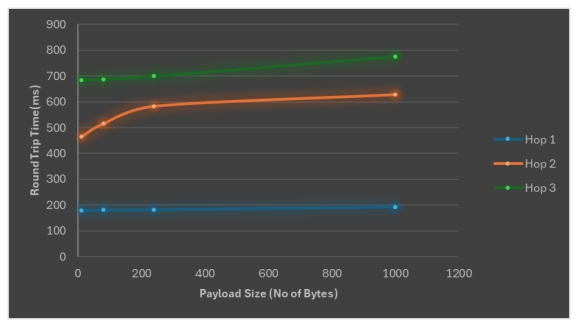
4.2 Round-Trip Time
-
Round-Trip Time (RTT) is the total time required for a data packet to travel from the source node to the destination node and back. It is a key metric for evaluating network latency and responsiveness.
-
In a Thread network, RTT generally increases as payload size increases because of additional transmission and processing overhead.
-
Network latency is evaluated by measuring the RTT of unicast ICMP Echo Request packets. Packets with payload sizes of 10, 80, 240, and 1000 bytes are sent to devices across different sectors, covering both nearby and multi-hop paths. The RTT for each packet is recorded individually for all devices. These measurements capture the effects of packet size, fragmentation, and hop count on round-trip time here.
-
Analyzing the collected RTT values makes it possible to assess the network’s end-to-end delay characteristics. This provides insight into the responsiveness and overall performance of the Thread network under realistic operating conditions. Overall, RTT-based evaluation helps show how efficiently the network delivers packets across different scenarios.
| Payload Size (Bytes) | Hop 1 RTT (ms) | Hop 2 RTT (ms) | Hop 3 RTT (ms) |
|---|---|---|---|
| 10 | 180.12 | 465.22 | 685 |
| 80 | 181.68 | 515.74 | 687.86 |
| 240 | 183.36 | 583.18 | 699.48 |
| 1000 | 194.22 | 628.28 | 774.36 |