
4.5 Throughput
-
Each IPv6 Thread packet is carried in an IEEE 802.15.4 data frame. The total transmitted packet size is determined by the combined header overhead, including PHY, MAC, 6LoWPAN, IPv6, and UDP, as well as the payload size. Understanding this distinction is important when evaluating network performance, particularly throughput.
-
Throughput is the amount of data successfully delivered from the source node to the destination node over a given period. It is an important metric for evaluating network efficiency and capacity when transmitting application data. The throughput test was conducted to measure the data-transmission capability of the Thread network under different communication scenarios.
-
Throughput was evaluated under both single-hop and multi-hop scenarios.
-
In the single-hop scenario, the transmitting node communicates directly with the receiving node without intermediate Routers. Because the data travels over a single wireless link, this scenario represents the maximum achievable throughput under less RF interference and direct accessibility.
-
In the multi-hop scenario, packets are transmitted from the source node to the destination node through one or more intermediate Thread Routers. Each Router forwards the packet to the next node until it reaches the final destination. In this case, throughput may be lower than in the single-hop scenario because each intermediate Router must receive and retransmit the packet. This adds processing time, channel usage, and the potential for retransmissions.
-
To assess the impact of packet size on network performance, throughput tests were conducted using packet sizes of 10 bytes, 80 bytes, 240 bytes, and 1000 bytes. This test set includes both non-fragmented and fragmented packets, enabling evaluation of network behavior for direct transmissions as well as for larger packets that require fragmentation and reassembly at the network layer.
-
During the test, a continuous stream of packets was transmitted from the source node to the destination node, and the amount of successfully received data was measured over a defined time interval. Throughput was then calculated based on the total amount of data received.Note: The throughput data presented in this document refers to User Datagram Protocol (UDP) throughput.
-
UDP throughput represents the application-layer data rate, or the amount of useful payload transmitted per second. It includes only the UDP payload and excludes protocol overhead at the network and MAC layers.
| UDP Payload (Bytes) | Hop 1 Throughput (kbps) | Hop 2 Throughput (kbps) | Hop 3 Throughput (kbps) |
|---|---|---|---|
| 10 | 0.9 | 0.32 | 0.24 |
| 80 | 7.22 | 2.56 | 1.86 |
| 200 | 21.67 | 7.69 | 5.81 |
| 1000 | 90.77 | 32.75 | 24.9 |
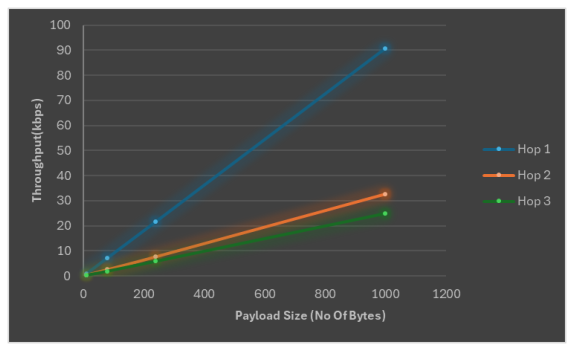
The results demonstrate how efficiently the Thread network handles data transmission under different payload sizes and routing conditions. Comparing throughput values between single-hop and multi-hop scenarios also helps understand the impact of routing and network topology on overall data performance.