8 Key Management
Describes key types, slot numbering, the key registry, and PUF key wrapping.
Key Concepts
| Term | Definition |
|---|---|
| Key registry | In-memory list
(key_slots[]) that accumulates all keys loaded during a session.
Maximum 10 entries. |
| VSS slot | A numbered position (2-127) in the VSS where a key is stored on-device |
| Key code | A PUF-wrapped version of a key. Can only be unwrapped on the same physical device. Stored in slot `0x80 \ |
| Signing key | The first asymmetric key
(slot 2) used by hsmsfmdgen.exe to sign the FWMD |
Key Types Supported
| Type | Subtype | Generation Methods | Step |
|---|---|---|---|
| Asymmetric ECC P-256 | ecc_p256 | TPDS software, load from file, PUF hardware | 1, 1b |
| Symmetric AES-128 | aes128 | Load from file, manual hex entry | 1b |
| Symmetric AES-256 | aes256 | Load from file, manual hex entry | 1b |
Key Slot Numbering Convention
 Slot range     Usage
 ----------     -----
   0 -   1      Reserved (not used)
   2            Secure Boot signing key (Step 1, fixed)
   3 - 255      Freely available for user keys and key codes
keycode_slot = 0x80 | original_slot is used so that the LED demo
application can locate key codes and verify them against the original keys. This is not a
hardware or ROM Boot requirement -- in production, any slot from 3 to 255 can hold either a
plain key or a key code, at the user's discretion.Key Registry
Each entry in key_slots[] is a dictionary:
| Field | Type | Description |
|---|---|---|
slot | int | VSS slot index (2-127) |
type | str | "asymmetric" or "symmetric" |
subtype | str | "ecc_p256",
"aes128", or "aes256" |
privatekey | str | Hex string (asymmetric private key) |
publickey | str | Hex string (asymmetric public key X\ |
public_numbers | obj | ec.EllipticCurvePublicNumbers (has .x,
.y) |
key_data | str | Hex string (symmetric key bytes) |
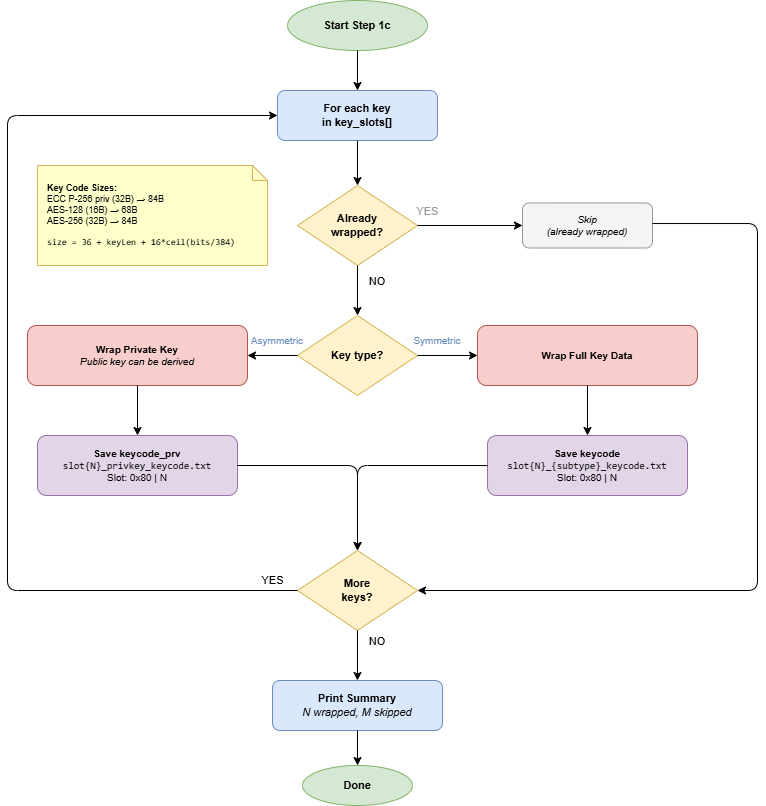
keycode | str | Hex string of PUF-wrapped symmetric key (set by Step 1c) |
keycode_prv | str | Hex string of PUF-wrapped private key (set by Step 1c) |
label | str | Human-readable description |
PUF Key Wrapping
The PUF produces a device-unique wrapping that binds keys to a specific chip. A wrapped key (key code) can only be unwrapped on the device that created it.
Why this matters: When key codes are used (Step 1c), the original key material does not need to be stored anywhere. The VSS only contains the opaque key codes, and the application firmware recovers the original keys at runtime by calling the PUF unwrap function. This means:
-
No plaintext keys on-device: an attacker reading the Flash sees only key codes, which are cryptographically bound to that specific chip's PUF and cannot be used on another device
-
No plaintext keys off-device: after provisioning, the original key material can be discarded. The device is self-sufficient -- it reconstructs the keys from the key codes using its own PUF.
-
Clone-resistant: copying the Flash contents to another chip is useless because the PUF response differs per silicon die
Key code size formula (from HSM firmware DRV_PUF_KEY_CODE_SIZE):
keyCodeSize = 36 + keyLen + 16 * ceil(keyLenBits / 384)
| Key Type | Key Length | Key Code Size |
|---|---|---|
| ECC P-256 private (32 B) | 32 | 84 bytes |
| AES-128 (16 B) | 16 | 68 bytes |
| AES-256 (32 B) | 32 | 84 bytes |
| ECC P-256 public (64 B) | 64 | 132 bytes |