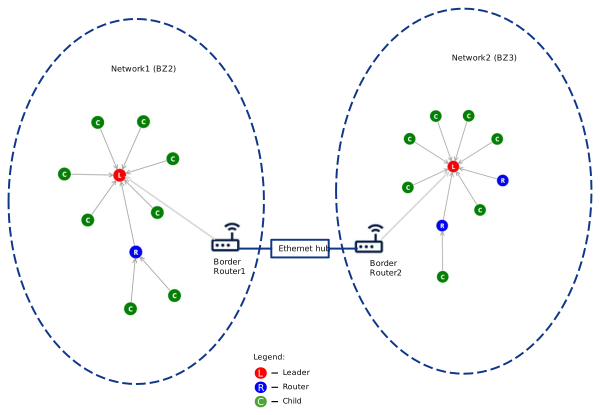
2.7 Communication Across Two Different Thread Networks
A Thread Border Router connects a IEEE® 802.15.4, Thread-based network to external IP networks such as Ethernet or Wi‑Fi®. It acts as a gateway, enabling Thread devices, which are typically low power and operate within a mesh network, to communicate with devices outside the Thread network, including cloud services and other IP-based systems.
The border router's significance lies in several key functions:
- Providing external connectivity, allowing Thread nodes to access the Internet and other networks.
- Enabling inter-partition communication, allowing different Thread partitions to exchange data when multiple Border Routers are present.
- Supporting service discovery and routing, ensuring that packets are forwarded correctly between Thread and non-Thread networks.
- Improving network scalability and reliability because multiple Border Routers prevent a single point of failure.
In this setup, the Thread network is configured with two separate partitions, each operating within its own sector. The first partition consists of 10 BZ3 nodes connected to a single Border Router, while the second partition consists of 10 BZ2 nodes connected to another Border Router. Each partition independently forms its own network structure with a designated Leader. Communication between the two partitions is established through the Leaders, enabling data exchange across sectors through their respective Border Routers.