
4.14.1 Sleep Mode and System Power Management
This section applies to devices of revision D0 and later.
Figure 4-13 shows an example of how power should be supplied in a system that will use the low-power sleep mode of the device. In this diagram, VDDAU is provided by a constant supply, so that it is always enabled, even during sleep mode. On system power-up, once this supply is active, the INH pin will be asserted so that its active high output can drive the enable pins of the external switchable supplies for VDDA and VDDP.
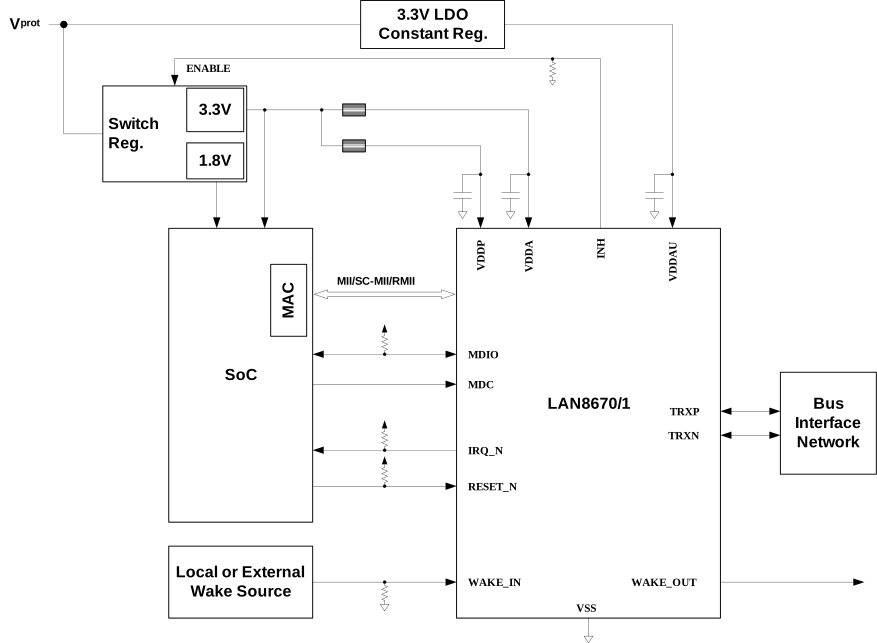
After the device enters sleep mode, the INH pin will enter a high-impedance state. The external resistor will pull the signal down to ground, which will then disable any voltage sources controlled by INH. This can be used to disable power to additional devices, including, when needed, the station host controller.
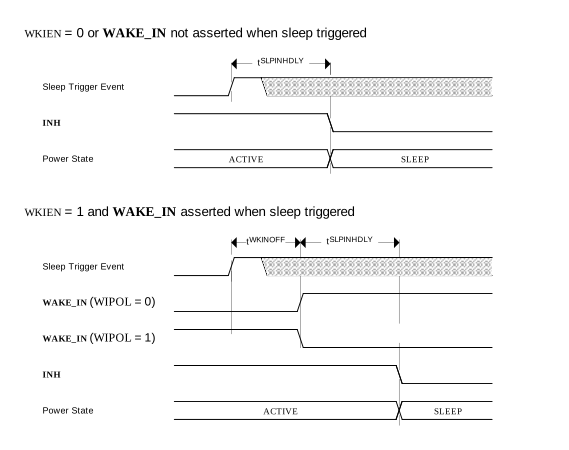
Some systems may require a delay between the trigger for the start of sleep mode and disable of the local power supplies, for example, to allow for other nodes on the mixing segment to go quiet. Delay timing is configured with the Sleep Inhibit Delay (SLPINHDLY) field of the Sleep Control 0 (SLPCTL0) register. If wake from the WAKE_IN pin is enabled (WKIEN=1), the WAKE_IN pin must be deasserted before the Sleep Inhibit Delay timer will be started. See Figure 4-14 for a diagram illustrating the timing from when SLEEP state is commanded until the INH pin is released and the SLEEP state is entered.
In sleep mode, a small amount of current is drawn from VDDAU to monitor for a wake condition. The wake condition can be a WAKE_IN pulse provided from another device, or a signal on the wire harness from another node on 10BASE-T1S network. After a wake condition is detected, INH is actively driven high, enabling the external power supplies, which should be fully powered within 1 ms of INH being driven high according to the OPEN Alliance 10BASE‑T1S Sleep/Wake-Up Specification. Once all power supplies are above their thresholds, the device will behave as if it had been reset by the RESET_N pin, and will assert IRQ_N to signal that the device is ready to be configured as described in the Initialization section.
The VDDA and VDDP power supplies are not required to be powered down prior to a wake-up event. In this case, the registers retain their values and the device does not need to be re-configured. However, if the VDDA and VDDP supplies are disabled, then the device must be re-initialized upon wake.