
1.7 DMAC Memory Transfer
This example application demonstrates how to use the DMAC peripheral to do a memory to memory transfer.
Description
The application uses a software trigger to initiate a memory-memory transfer from the source buffer to the destination buffer with 16-bit beat size and 32-bit beat size. The number of cycles taken for the DMA transfer is measured using the SysTick and reported on the console.
Downloading and Building the Application
To clone or download this application from Github, go to the main page of this repository and then click Clone button to clone this repository or download as zip file.
Path of the application within the repository is apps/dmac/dmac_memory_transfer.
To build the application, refer to the following table and open the project using its IDE.
| Project Name | Description |
|---|---|
| pic32cm_pl10_curiosity_nano.X | MPLAB X project for PIC32CM PL10 Curiosity Nano Evaluation Kit |
Setting Up the Hardware
The following table shows the target hardware for the application projects.
| Project Name | Board |
|---|---|
| pic32cm_pl10_curiosity_nano.X | PIC32CM PL10 Curiosity Nano Evaluation Kit |
Setting Up PIC32CM PL10 Curiosity Nano Evaluation Kit
- Connect the Debug USB port on the board to the computer using a USB Type-C cable
Running the Application
- Open the terminal application (e.g., Tera term) on the computer.
- Connect to the Curiosity Virtual
COM port and configure the serial settings as follows:
- Baud: 115200
- Data: 8 bits
- Parity: None
- Stop: 1 bit
- Flow Control: None
- Build and program the application using its IDE.
- LED indicates the success or failure:
- LED is turned ON when the DMAC memory transfer is successful
- Refer to the following
table for details of LED:
Board LED Name PIC32CM PL10 Curiosity Nano Evaluation Kit LED0
- Observe output message in console
as follows:
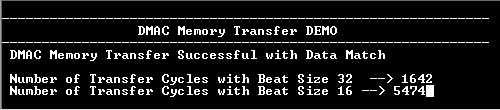 Note: The number of transfer cycles may vary.