
11.2.4 Finite State Machine
- Sequential Current State Register: The register, a set of n-bit flip-flops (state vector flip-flops) clocked by a single clock signal is used to hold the state vector (current state or simply state) of the FSM. A state vector with a length of n-bit has 2n possible binary patterns, known as state encoding. Often, not all 2npatterns are needed, so the unused ones should be designed not to occur during normal operation. Alternatively, an FSM with m-state requires at least log2(m) state vector flip-flops.
- Combinational Next State Logic: An FSM can only be in one state at any given time, and each active transition of the clock causes it to change from its current state to the next state, as defined by the next state logic. The next state is a function of the FSM’s inputs and its current state.
- Combinational Output Logic: Outputs are normally a function of the current state and possibly the FSM’s primary inputs (in the case of a Mealy FSM). Often in a Moore FSM, you may want to derive the outputs from the next state instead of the current state, when the outputs are registered for faster clock-to-out timings.
Moore and Mealy FSM structures are shown in Figures below
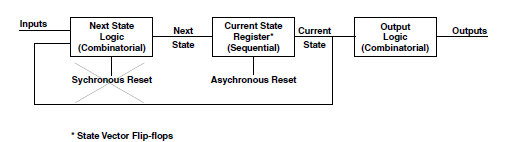
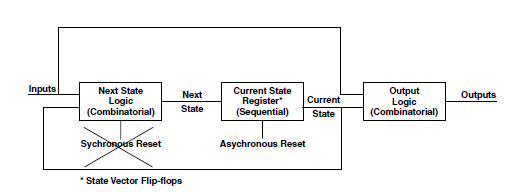
Use a reset to guarantee fail-safe behavior. This ensures that the FSM is always initialized to a known valid state before the first active clock transition and normal operation begins. In the absence of a reset, there is no way of predicting the initial value of the state register flip-flops during the “power up” operation of an Microchip FPGA. It could power up and become permanently stuck in an unencoded state. The reset should be implemented in the sequential current state process of the FSM description.
An asynchronous reset is generally preferred over a synchronous reset because an asynchronous reset does not require decoding unused states, minimizing the next state logic. Because FPGA technologies are register rich, “one hot” state machine implementations generated by the synthesis tool may generate optimal area and performance results