2.7.3.4 Write Leveling
(Ask a Question)After the third step, the controller enters the write leveling mode. Any DFI compliant controller must follow this Write Leveling sequence to complete the training step:
- To enter the Write Leveling mode, the controller must issue Mode Register Set (MRS) to MR1 for DDR3/DDR4, MR2 for LPDDR3, and set the write leveling enable bit (DFI_WRLVL_EN = 1).
- After detecting DFI_WRLVL_EN =1, the Training IP starts the training algorithm and aligns CLK to DQS. Write leveling is a JEDEC defined method used to detect 0 to 1 transition on CLK by DQS.
- DQS samples the CLK value and feeds it back on the prime DQ on the DRAM DQ byte lane.
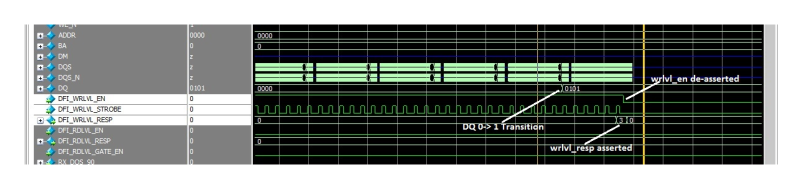
- When the prime DQ value transitions from 0 to 1, CLK is aligned to DQS within the JEDEC specified timing limits. The Training IP performs this procedure on all byte lanes concurrently.
- The controller sends continuous strobe (DFI_WRLVL_STROBE) pulses to capture DFI_WRLVL_RESP. DFI_WRLVL_STROBE initiates the capture of DFI_WRLVL_RESP within the PHY DQ bus.
- The Training IP asserts DFI_WRLVL_RESP = 1 indicating the completion of Write Leveling
to the controller.Note: In the Fast Simulation Mode, PHY ignores the WRLVL request without responding. The controller must bypass the write leveling, read gate leveling, and read eye training (Read Leveling) stages.
- When the controller receives the DFI_WRLVL_RESP asserted signal, it de-asserts the write to mode register MR1 and also de-asserts DFI_WRLVL_EN to disable write leveling enable bit.
- The delay values detected for each byte lane are stored in the PHY lane controller. The following figure shows the controller sampling DFI_WRLVL_RESP and disabling DFI_WRLVL_EN.