2.13.7 Voltage Regulator
(Ask a Question)| Symbol | Parameter | Test Conditions | Min. | Typ. | Max. | Unit | |
|---|---|---|---|---|---|---|---|
| VOUT | Output voltage | TJ = 25 °C | — | 1.425 | 1.5 | 1.575 | V |
| VOS | Output offset voltage | TJ = 25 °C | — | — | 11 | — | mV |
| ICC33A | Operation current | TJ = 25 °C | ILOAD = 1 mA | — | 3.4 | — | mA |
| ILOAD = 100 mA | — | 11 | — | mA | |||
| ILOAD = 0.5 A | — | 21 | — | mA | |||
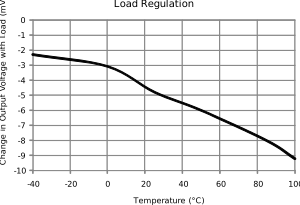
| ΔVOUT | Load regulation | TJ = 25 °C | ILOAD = 1 mA to 0.5 A | — | 5.8 | — | mV |
| ΔVOUT | Line regulation | TJ = 25 °C | VCC33A = 2.97V to 3.63V ILOAD = 1 mA | — | 8 | — | mV/V |
| VCC33A = 2.97V to 3.63V ILOAD= 100 mA | — | 8 | — | mV/V | |||
| VCC33A = 2.97V to 3.63V ILOAD = 500 mA | — | 8 | — | mV/V | |||
| Dropout voltage1 | TJ = 25 °C | ILOAD = 1 mA | — | 0.65 | — | V | |
| ILOAD = 100 mA | — | 0.84 | — | V | |||
| ILOAD = 0.5 A | — | 1.35 | — | V | |||
| IPTBASE | PTBase current | TJ = 25 °C | ILOAD = 1 mA | — | 48 | — | µA |
| ILOAD = 100 mA | — | 736 | — | µA | |||
| ILOAD = 0.5 A | — | 12 | — | mA | |||
| Startup time2 | TJ = 25 °C | — | — | 200 | — | ms | |
Note:
- Dropout voltage is defined as the minimum VCC33A voltage. The parameter is specified with respect to the output voltage. The specification represents the minimum input-to-output differential voltage required to maintain regulation.
- Assumes 10 µF.