
9.10.2 Configuring Security Settings in FlashPro®
To configure the security settings:
- From the Configuration menu, choose Load Programming File (PDB).
- Select the PDB file and click Open, this loads the programming file.
- From the Configuration
menu, choose PDB Configuration. The
Programming File Generator appears.
Figure 9-120. Programming File Generator 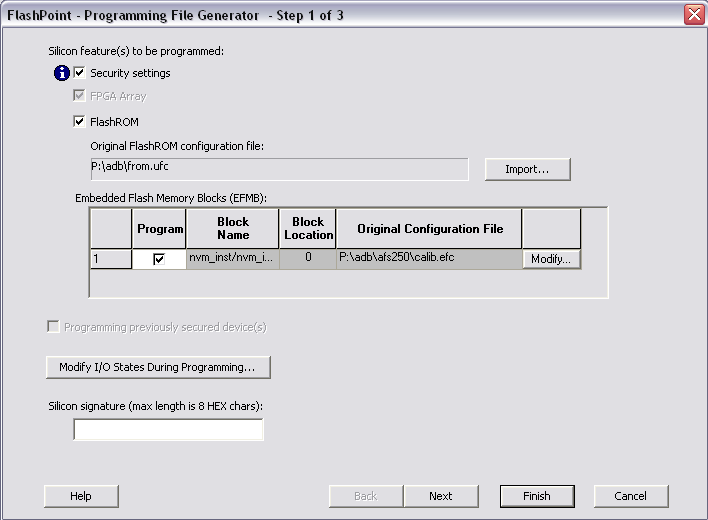
- Check the Security Settings
checkbox and click Next. This brings up the
Security Settings dialog box.
Figure 9-121. Security Settings Dialog Box 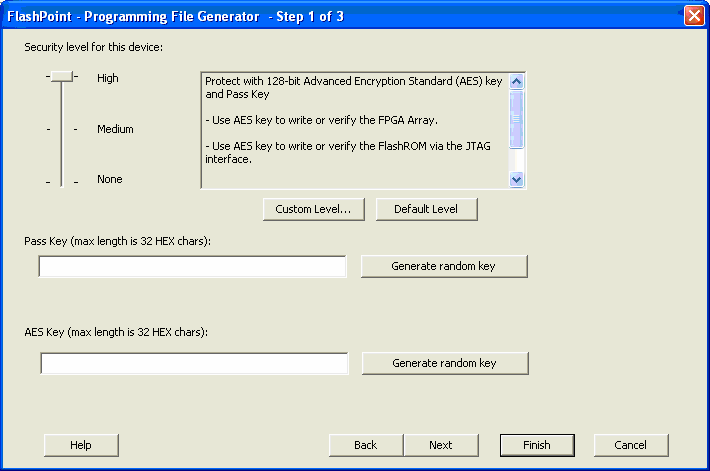
- Move the sliding bar to select the security
level for FPGA, FlashROM, and EFMB (see the following table for a description of the
security levels).
Table 9-5. Security Levels Descriptions Security Level Security Option Description High Protect with a 128‑bit Advanced Encryption Standard (AES) key and a Pass Key Access to the device is protected by both an AES Key and a Pass Key. Write and Verify operations for the FPGA Array use a 128‑bit AES‑encrypted bitstream. From the JTAG interface, Write operations for FlashROM use a 128‑bit AES‑encrypted bitstream. Readback of FlashROM content through the JTAG interface is protected by the Pass Key. Readback of FlashROM content from the FPGA Array is allowed. Medium Protect with Pass Key Write and Verify operations for the FPGA Array require a Pass Key. From the JTAG interface, Read and Write operations for FlashROM content require a Pass Key, while Verify operations do not. Readback of FlashROM content from the FPGA Array is allowed. None No Security Write and Verify operations for the FPGA Array do not require keys. Read, Write, and Verify operations for FlashROM content also do not require keys. - Enter the Pass Key
and/ or the AES Key as appropriate. You can generate a
random key by clicking the Generate random key button.
The Pass Key protects all the Security Settings for the FPGA Array and/or FlashROM.
The AES Key decrypts FPGA Array and/or FlashROM programming file content. Use the AES Key if you intend to program the device at an unsecured site or if you plan to update the design at a remote site in the future.
- Click Finish.
You can also customize the security levels by clicking the Custom Level button.