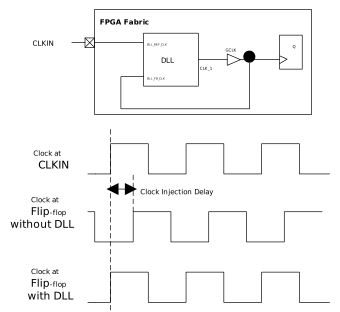
4.4.1.3 Clock Injection Delay Removal Mode
(Ask a Question)In Clock Injection Delay Removal mode, the DLL is used to compensate for the clock injection delay associated with the source-synchronous receive interfaces. Clock injection delay is the delay from the input pin of the device to a destination element, such as a flip-flop.
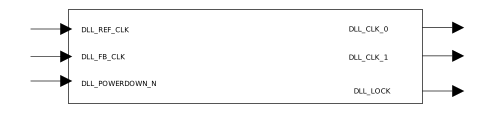
| Port Name | Direction | Description |
|---|---|---|
| DLL_REF_CLK | Input | Reference clock |
| DLL_FB_CLK | Input | Feedback clock |
| DLL_POWERDOWN_N | Input | DLL power-down input (active low): 1'b0—Power-down state 1'b1—DLL is enabled |
| DLL_CLK_0 | Output | Primary clock output |
| DLL_CLK_1 | Output | Secondary clock output |
| DLL_LOCK | Output | Lock output |
The external clock input is connected to the DLL reference clock and the DLL clock output is connected as DLL feedback clock through global clock routing, as shown in the following figure. The DLL in the clock injection delay removal mode adds delay to the reference clock to align it with the feedback clock, thereby matching delays for the global clock network. When the reference and feedback clocks are phase-locked, the aggregate delay of one or more delay cells and the clock distribution network corresponds to an integer multiple of the clock cycle of the reference clock. This mode supports the distribution of DLL_CLK_0 and DLL_CLK_1 to the global and high-speed I/O clock networks. Only one can be fed back to DLL.