
17.7.2 Flash Memory Block Macro
Flash Memory Block
Flash Memory Block is available across the Fusion device family.
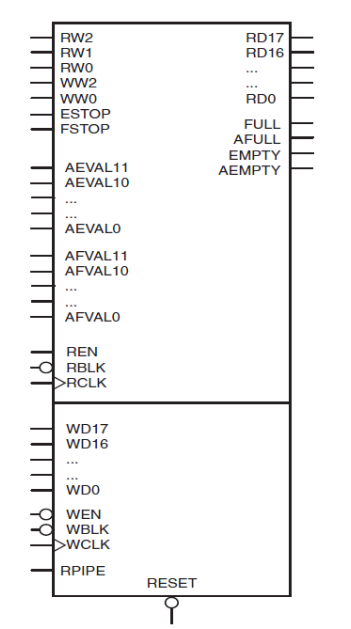
- Function: Flash memory block builder for use with SmartGen and Fusion.
- Inputs/Outputs: See the description as follows for an explanation of the inputs and outputs available on the Flash memory block macro.
- Address bits are MSB justified, unlike RAM4K9 and RAM512X18 in which the address bits are LSB justi-fied.
- Write operation updates write data into the block buffer ONLY. To store data permanently into the Flash Memory Block array writes to a page must be followed by a program operation of the same page.
- The simulation models always execute copy page from Flash memory block array (internal operation) in 65 clock cycles; in silicon the behavior is non-deterministic (63-67 clock cycles). This mismatch is reflected in the number of cycles BUSY is asserted.
Operations on Flash memory block are synchronous to rising-edge of CLK.
Flash Memory Block Pin Description
All Flash memory block signals are active high, except for RESET which is active low. The Flash memory block is a completely synchronous model sensitive to rising edge of CLK input.
| NAME | FUNCTION |
|---|---|
| ADDR[17:0] | Byte-offset into the Flash memory block array or block buffer of page buffer |
| WD[31:0] | Write data |
| DATAWIDTH[31:0] | 00 = 1-byte in data_in/out[7:0] 01 = 2-bytes in data_in/out[15:0] 10/11 = 4-bytes in data_in/out[31:0] |
| REN | When asserted, initiates a read operation |
| READNEXT | When asserted with REN, initiates a read from next address after read to current address is complete. |
| PAGESTATUS | When asserted with read, initiates a read page status operation |
| WEN | When asserted, interface data is stored into the assembly buffer. |
| ERASEPAGE | When asserted, erase addressed page (program all zeroes). |
| PROGRAM | When asserted, write the contents of the assembly buffer into the cell array page addressed. |
| SPAREPAGE | When asserted, the sector addressed is used to access the spare page within that sector. |
| AUXBLOCK | When asserted, the page addressed is used to access the auxiliary block within that page. |
| UNPROTECTPAGE | When asserted, the page addressed is copied into the AB and the AB made writeable. |
| OVERWRITEPAGE | When asserted, the page addressed is overwritten with the contents of the AB if the page is writeable. |
| DISCARDPAGE | When asserted, the contents of the AB are discarded so that a new page write can be started. |
| OVERWRITEPROTECT | When asserted, all program operations set the overwrite protect bit in the auxiliary block of the page being programmed. |
| PAGELOSSPROTECT | When asserted, a modified assembly buffer must be programmed or discarded before accessing a new page. |
| PIPE | When asserted with REN, read operation completes in 6 cycles. Required to be asserted for CLK speeds above 50MHz. |
| LOCKREQUEST | Request to lock user access to Flash memory block array. |
| CLK | Input clock. All operations and status are synchronous to rising-edge of this clock. |
| RESET | When asserted resets the state of the Flash memory block. |
| RD[31:0] | Read data to be sampled when BUSY=0. |
| STATUS[1:0] | Status of the last operation completed:
|
Simulation Details for Flash Memory Block
The Flash memory block array can be pre-loaded with user-defined data. For simulation purposes, you can specify a memory initialization file by over-riding the parameter MEMORYFILE in the verilog netlist and the generic MEMORYFILE in vital netlist.
The memory array declared in simulation models stores data that is one block wide. It is 64k x 140 bits. The addressing scheme for accessing this array consists of 16 bits, as shown in the following figure.
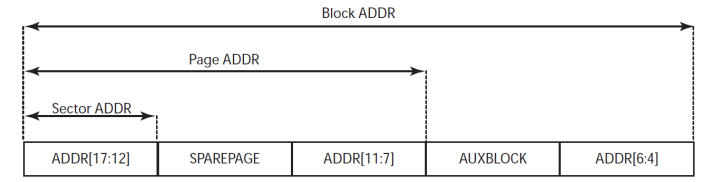
ADDR[17:0] is the Flash memory block interface address, SPAREPAGE and AUXBLOCK are input signals.
- Each line MUST contain a string of fixed length (=35 characters) and start with an "@" if it corresponds to an address.
- Each line following the address line corresponds to a block of data starting at the block address specified in the address line. This applies until the next line with an address specifier (@) is encountered.
- Each data block consists of 35 hex characters. Hex[31:0] are the data characters corresponding to 16 bytes of user data with Hex[1:0] corresponding to Byte0 and Hex[31:30] corresponding to Byte15. Hex[34:32] are ECC related bits and must be addressed manually.
@Block_Address_0
Block_Data_0 ( required )
Block_Data_1 ( optional )
Block_Data_2 ( optional )
...
...
Block_Data_8 ( Aux block data for this page, optional )
@Block_Address_n
Block_Data_n ( required )
Block_Data_n+1 ( optional )
Block_Data_n+2 ( optional )
...
...
...
Block_Data_n+8 ( Aux block data for this page, optional )
@000…0000 // beginning with @, start address in hex. format. 0s to be padded
// between @ and hex address, to get a string of length 35.
ab101fd01… // 35 hexadecimal characters corresponding to each block of Flash memory
block cell
eab9c4……
@000…4030 // start address for next data stream
c805489e…. // 35 hexadecimal characters corresponding to each block of Flash memory
block cell
96986391…
User Controlled Generics
- FAST_SIM
- The generic/parameter FAST_SIM is included in pre-synthesis and pre-layout simulation models to reduce cycles wasted in executing the PROGRAM operation. The default is '1', which means the PROGRAM operation is executed with a 4μs simulated delay. You can choose to deactivate the operation by overriding FAST_SIM to 0, in which case PROGRAM is executed with a delay close to the real time of 8.4 ms. You can also choose this mode for post-layout simulations.
- WR_THR
- When the number of writes to a page in the Flash memory block array (program operation) exceeds the write threshold specified in the data sheet, the status returned is non-zero. Since the threshold is a huge value, WR_THR is provided to simulate this failure at a reduced number of writes. You can override the generic with any non-zero count (such as 10 or 12). The write-threshold-exceeded condition is produced on the 10th write to the same page in the Flash memory block array.