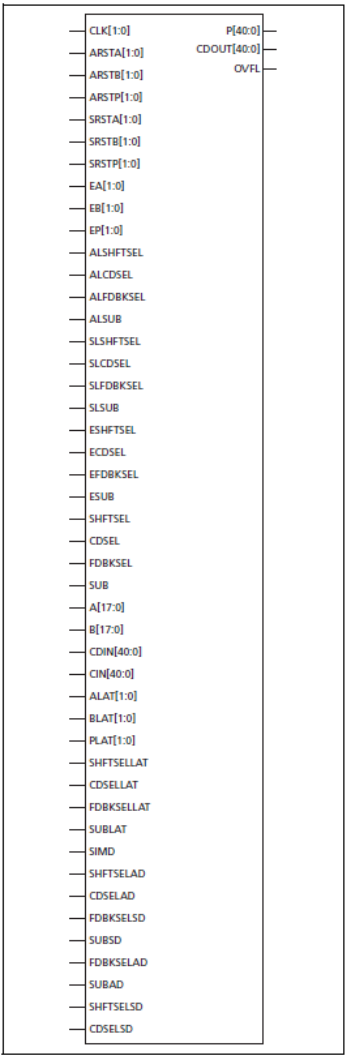
| SIMD | Input | Static | High | Single Instruction Multiple Data mode.When SIMD = 1, MATH block
is fractured into two 9 bit x 9 bit multipliersWhen SIMD = 0, it is
called the normal mode |
| | | | |
| CLK[1:0] | Input | Dynamic | Rising edge | Input clocks.CLK[1] is the clock for A[17:9], B[17:9], P[40:18],
OVFL,SHFTSEL, CDSEL, FDBKSEL and SUB registersCLK[0] is the clock
for A[8:0], B[8:0] and P[17:0] In normal mode, ensure CLK[1] =
CLK[0] |
|
| A[17:0] | Input | Dynamic | High | Input data A |
| ALAT[1:0] | Input | Static | High | Bypass data A registersALAT[1] is for A[17:9]. Connect to 1, if
not registeredALAT[0] is for A[8:0]. Connect to 1, if not registered
In normal mode, ensure ALAT[0] = ALAT[1] |
| ARSTA[1:0] | Input | Dynamic | Low | Asynchronous reset for data A registers.ARSTA[1] is for A[17:9].
Connect to 1, if not registeredARSTA[0] is for A[8:0]. Connect to 1,
if not registered In normal mode, ensure ARSTA[1] = ARSTA[0] |
| SRSTA[1:0] | Input | Dynamic | Low | Synchronous reset for data A registersSRSTA[1] is for A[17:9].
Connect to 1, if not registeredSRSTA[0] is for A[8:0]. Connect to 1,
if not registered In normal mode, ensure SRSTA[1] = SRSTA[0] |
| EA[1:0] | Input | Dynamic | High | Enable for data A registersEA[1] is for A[17:9]. Connect to 1, if
not registeredEA[0] is for A[8:0]. Connect to 1, if not registered
In normal mode, ensure EA[1] = EA[0] |
|
| B[17:0] | Input | Dynamic | High | Input data B |
| BLAT[1:0] | Input | Static | High | Bypass data B registers.BLAT[1] is for B[17:9]. Connect to 1, if
not registered.BLAT[0] is for B[8:0]. Connect to 1, if not
registered. In normal mode, ensure BLAT[0] = BLAT[1]. |
| ARSTB[1:0] | Input | Dynamic | Low | Asynchronous reset for data B registers.ARSTB[1] is for B[17:9].
Connect to 1, if not registered.ARSTB[0] is for B[8:0]. Connect to
1, if not registered. In normal mode, ensure ARSTB[1] =
ARSTB[0]. |
| SRSTB[1:0] | Input | Dynamic | Low | Synchronous reset for data B registers.SRSTB[1] is for B[17:9].
Connect to 1, if not registered.SRSTB[0] is for B[8:0]. Connect to
1, if not registered. In normal mode, ensure SRSTB[1] =
SRSTB[0]. |
| EB[1:0] | Input | Dynamic | High | Enable for data B registers.EB[1] is for B[17:9]. Connect to 1,
if not registered.EB[0] is for B[8:0]. Connect to 1, if not
registered. In normal mode, ensure EB[1] = EB[0]. |
| P[40:0] | Output | | High | Result data.Normal modeP = C + (A × B), when SUB = 0 P = C - (A × B), when SUB = 1SIMD mode PL = AL × BLPH = CH + (AH × BH), when SUB = 0PH = CH - (AH × BH), when SUB = 1Notation:AL = A[8:0], AH = A[17:9]BL = B[8:0], BH = B[17:9]PL = P[17:0], PH = P[40:18] CH = C[40:18].See Table 4 on page 324 to see how operand C is obtained from CIN, Por CDIN. |
| OVFL | Output | | High | Overflow.Normal modeif C +/- (A x B) > (240 ) - 1, then OVFL = 1 if C +/- (A x B) < -(240), then OVFL = 1otherwise, OVFL = 0SIMD modeif CH +/- (AH x BH) > (222) - 1, then OVFL = 1 if CH +/- (AH x BH) < -(222), then OVFL = 1otherwise, OVFL = 0 |
| PLAT[1:0] | Input | Static | High | Bypass result P registers.PLAT[1] is for P[40:18] and OVFL. Connect to 1, if not registeredPLAT[0] is for P[17:0]. Connect to 1, if not registered In normal mode, ensure PLAT[0] = PLAT[1]. |
| ARSTP[1:0] | Input | Dynamic | Low | Asynchronous reset for result P registers.ARSTP[1] is for P[40:18] and OVFL. Connect to 1, if not registered.ARSTP[0] is for P[17:0]. Connect to 1, if not registered In normal mode, ensure ARSTP[1] = ARSTP[0]. |
| SRSTP[1:0] | Input | Dynamic | Low | Synchronous reset for result P registers.SRSTP[1] is for P[40:18] and OVFL. Connect to 1, if not registered.SRSTP[0] is for P[17:0]. Connect to 1, if not registered. In normal mode, ensure SRSTP[1] = SRSTP[0]. |
| EP[1:0] | Input | Dynamic | High | Enable for result P registers.EP[1] is for P[40:18] and OVFL. Connect to 1, if not registered.EP[0] is for P[17:0]. Connect to 1, if not registered. In normal mode, ensure EP[1] = EP[0]. |
|
| CDOUT[40:0] | Output | Cascade | High | Cascade output of result P.CDOUT is the same as P. The entire bus must either be dangling or drive an entire CDIN of another MATH block in cascaded mode. |
| | | | |
| CIN[40:0] | Input | Dynamic | High | Routed input for operand C.In SIMD mode, connect CIN[17:0] to 0.See Table 4 on page 324 to see how CIN is propagated to operand C. |
| CDIN[40:0] | Input | Cascade | High | Cascaded input for operand C.The entire bus must be driven by an entire CDOUT of another MATH block.See Table 4 on page 324 to see how CDIN is propagated to operand C. |
|
| SHFTSEL | Input | Dynamic | High | Arithmetic right-shift for operand C.When asserted, a 17-bit arithmetic right-shift is performed on operand C going into the accumulator.In SIMD mode, SHFTSEL is ignored.See Table 4 on page 324 to see how operand C is obtained from CIN, P or CDIN. |
| SHFTSELLAT | Input | Static | High | Bypass SHFTSEL register. Connect to 1, if not registered. |
| ALSHFTSEL | Input | Dynamic | Low | Asynchronous load for SHFTSEL register. Connect to 1, if not registered.When asserted, SHFTSEL register is loaded with SHFTSELAD. |
| SHFTSELAD | Input | Static | High | Asynchronous load data for SHFTSEL register. |
| SLSHFTSEL | Input | Dynamic | Low | Synchronous load for SHFTSEL register. Connect to 1, if not registered.See Table 2 on page 324 |
| SHFTSELSD | Input | Static | Low | Synchronous load data for SHFTSEL register. See Table 2 on page 324 |
| ESHFTSEL | Input | Dynamic | High | Enable for SHFTSEL register. Connect to 1, if not registered. See Table 2 on page 324 |
|
| CDSEL | Input | Dynamic | High | Select CDIN for operand C.When CDSEL = 1, propagate CDIN.When CDSEL = 0, propagate CIN or P depending on FDBKSEL. In SIMD mode, CDSEL is ignored for CDIN[17:0] and only CDIN[40:18] is propagated.See Table 4 on page 324 to see how operand C is obtained from CIN, P or CDIN. |
| CDSELLAT | Input | Static | High | Bypass CDSEL register. Connect to 1, if not registered. |
| ALCDSEL | Input | Dynamic | Low | Asynchronous load for CDSEL register. Connect to 1, if not registered. When asserted, CDSEL register is loaded with CDSELAD. |
| CDSELAD | Input | Static | High | Asynchronous load data for CDSEL register. |
| SLCDSEL | Input | Dynamic | Low | Synchronous load for CDSEL register. Connect to 1, if not registered. See Table 2 on page 324. |
| CDSELSD | Input | Static | Low | Synchronous load data for CDSEL register. See Table 2 on page 324. |
| ECDSEL | Input | Dynamic | High | Enable for CDSEL register. Connect to 1, if not registered. See Table 2 on page 324. |
|
| FDBKSEL | Input | Dynamic | High | Select the feedback from P for operand C.When FDBKSEL = 1, propagate the current value of result P register. Ensure PLAT[1] = 0 and CDSEL = 0.When FDBKSEL = 0, propagate CIN. Ensure CDSEL = 0. To load P from CIN, ensure either A = 0 or B = 0.In SIMD mode, FDBKSEL is ignored for P[17:0] and only P[40:18] is propagated.See Table 4 on page 324 to see how operand C is obtained from CIN, P or CDIN. |
| FDBKSELLAT | Input | Static | High | Bypass FDBKSEL register. Connect to 1, if not registered. |
| ALFDBKSEL | Input | Dynamic | Low | Asynchronous load for FDBKSEL register. Connect to 1, if not registered.When asserted, FDBKSEL register is loaded with FDBKSELAD. |
| FDBKSELAD | Input | Static | High | Asynchronous load data for FDBKSEL register. |
| SLFDBKSEL | Input | Dynamic | Low | Synchronous load for FDBKSEL register. Connect to 1, if not registered.See Table 2 on page 324. |
| FDBKSELSD | Input | Static | Low | Synchronous load data for FDBKSEL register. See Table 2 on page 324. |
| EFDBKSEL | Input | Dynamic | High | Enable for FDBKSEL register. Connect to 1, if not registered. See Table 2. |
| SUB | Input | Dynamic | High | Subtract operation.When SUB = 1, perform Two's complement subtraction to get result P= C - (A x B).When SUB = 0, perform Two's complement addition to get result P = C + (A x B). |
| SUBLAT | Input | Static | High | Bypass SUB register. Connect to 1, if not registered. |
| ALSUB | Input | Dynamic | Low | Asynchronous load for SUB register. Connect to 1, if not registered. When asserted, SUB register is loaded with SUBAD. |
| SUBAD | Input | Static | High | Asynchronous load data for SUB register. |
| SLSUB | Input | Dynamic | Low | Synchronous load for SUB register. Connect to 1, if not registered. See Table 2. |
| SUBSD | Input | Static | Low | Synchronous load data for SUB register. See Table 2. |
| ESUB | Input | Dynamic | High | Enable for SUB register. Connect to 1, if not registered. See Table 2. |