5.22.1 About Bus Interfaces
A bus interface is a standard mechanism for specifying the interconnect rules between components or instances in a design. A bus definition consists of the roles, signals, and rules that define that bus type. A bus interface is the instantiation of that bus definition onto a component or instance.
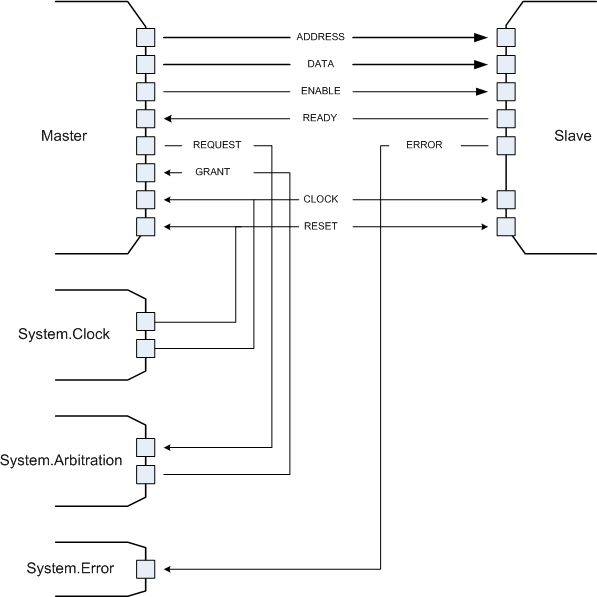
The available roles of a bus definition are master, slave, and system.
A master is the bus interface that initiates a transaction (such as read or write) on a bus.
A slave is the bus interface that terminates/consumes a transaction initiated by a master interface.
A system is the bus interface that does not have a simple input/output relationship on both master/slave. This could include signals that only drive the master interface, or only drive the slave interface, or drive both the master and slave interfaces. A bus definition can have zero or more system roles. Each system role is further defined by a group name. For example, you may have a system role for your arbitration logic, and another for your clock and reset signals.
Mirror roles are for bus interfaces that are on a bus core, such as CoreAHB or CoreAPB. They are equivalent in signal definition to their respective non-mirror version except that the signal directions are reversed.
The diagram below is a conceptual view of a bus definition.