
17.4.1.1 Pseudo Differential CVD Algorithm
The CVD allows measuring a capacitance connected to the CVDANx input. It can be used to detect a touch event in touch sensor applications.
The CVD measurement algorithm consists of two phases: Sample A and Sample B.
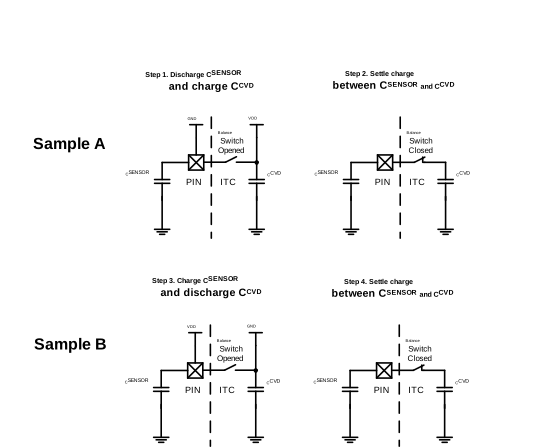
Sample A: The capacitive sensor CSENSOR is connected to I/O power (VDD, charged) and the internal CVD capacitors array CCVD is connected to ground (GND, discharged) as shown in Figure 17-2, step 1. Then, both capacitors are connected to balance a charge between them as shown in Figure 17-2, step 2. After the charge between the capacitors is settled, the resulting voltage is proportional to the ratio of the CSENSOR and CSENSOR+CCVD capacitances. Then this voltage is converted by the ADC3.
Sample B: The capacitive sensor CSENSOR is connected to ground (GND, discharged) and the internal CVD capacitors array CCVD is connected to I/O power (VDD, charged) (as shown in Figure 17-2, step 3). Then, both capacitors are connected to balance a charge between them, as shown in Figure 17-2, step 4. After the charge between the capacitors is settled, the resulting voltage is proportional to the ratio of the CCVD and CSENSOR+CCVD capacitances. Then this voltage is converted by the ADC3.
The ITC module internally calculates the difference between Sample A and Sample B and accumulates the result in the ITCRESx register in signed format. Equation 17-1 shows the relation between the result in the ADnRESx register and the capacitances of CSENSOR and CCVD:
To ensure maximum sensitivity, CSENSOR should be equal to or close to the CCVD value, which can be achieved by adjusting the CCVD capacitance using the CVDCAP[2:0] bits (ITCLSxSEQ[30:28]).
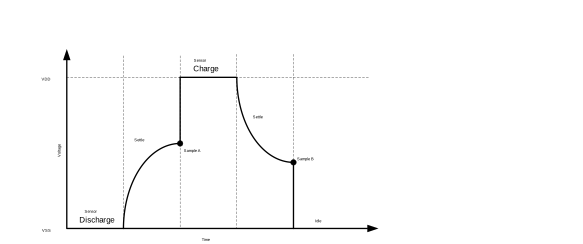
The typical waveform on the CVD Sensor is shown in Figure 17-3 below.
The CVD measures total capacitance, so as the base capacitance of a sensor decreases, the change in signal caused by a measured factor (such as a user’s finger in the case of a capacitive touch application) will increase. Active guards are a way of minimizing the base capacitance by reducing the electric potential between the sensor and its surrounding environment. When designing the guard for an application, the best solution is to encircle the sensor and guard trace completely. The guard trace should be placed between the sensor and any low impedance source. The guard signal should be as close as possible to the CVD waveform. To generate the sensor's guard signal, the CVDTXx pins selected in ITCTXA, ITCTXB and ITCTXC registers and controlled in Acquisition Sequencer commands can be used.