2.2.19 Analog System Client
You can load the configuration file generated by the ASB into the Flash Memory System Builder. Once loaded, all the analog system components can be initialized by the Flash Memory System at start up.
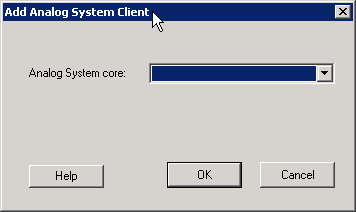
The Add Analog System Client opens with a blank field for the Configuration file. The Modify Analog System Client opens with the field filled in. Click the dropdown menu and select your Analog System core from the list.
Note: Note: Initialization of the Analog System must occur at less than 10 Mhz; the Analog Configuration MUX (ACM) inside the Analog Block runs at a maximum of 10 Mhz. The ACM contains the configuration data for the Analog channels. If you initialize at more than 10 MHz, you will overload the MUX.
Note: If necessary, a PLL and NGMUX can be used in conjunction to support driving the Analog System at a slow initialization frequency and a fast operating frequency.
You can load the configuration file generated by the ASB into the Flash Memory System Builder. Once loaded, all analog system components can be initialized by the Flash Memory System at startup.
When adding an Analog System client, the Add Analog System Client dialog box opens with an empty Configuration File field. When modifying an existing Analog System client, this field is pre‑populated. Use the drop‑down menu to select the appropriate Analog System core from the list.
If required, a PLL and NGMUX can be used together to allow the Analog System to operate at a low frequency during initialization and at a higher frequency during normal operation.