
2.2.12 Sequencing in Fusion
For Temperature and Current channels, the analog‑to‑digital converter (ADC) requires a dedicated strobe signal to be asserted to initiate the conversion process. This strobe signal has strict timing and pulse‑width requirements, including both minimum high‑time and low‑time constraints.
After a high‑to‑low transition, the strobe signal must remain low for a minimum of 5 µs. In addition, the following minimum high‑time requirements apply:
- Current channel strobe: minimum high time of 5 µs
- Temperature channel strobe: minimum high time of 10 µs
Temperature Channel Sequencing
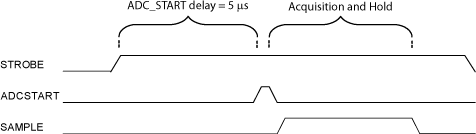
For Temperature channels, the sample sequencer automatically inserts a 5 µs delay before the ADC conversion begins. During this delay, the strobe signal for the selected channel is asserted. This ensures that the temperature‑monitor circuitry inside the ADC has sufficient time to settle to the correct value.
After the 5 µs delay has elapsed, ADC sampling begins. The duration of the sampling phase is determined by the acquisition time specified in the peripheral configuration dialog box. Once the sampling period is complete, the ADC conversion process starts.
Because of the automatic insertion of the 5 µs delay, the minimum acquisition time for Temperature channels is 5 µs. The combination of the acquisition time and the inserted delay satisfies the minimum strobe‑timing requirements for temperature monitoring, as illustrated in the following figure.
If the Analog System is configured in ADC‑only mode, the strobe‑timing requirements described in this section must be handled manually by the user.
ASSC Strobe Generation
The Analog Sample Sequence Controller (ASSC) generates the required strobe signals. The ASSC does not track elapsed time, past samples, or future samples. A strobe pulse remains active for the entire ASSC processing time for a given channel and is deasserted as soon as the sequencer advances to the next channel. As a result, strobe‑timing requirements must be satisfied through sequencing configuration and timing constraints.
To meet the strobe‑timing requirements, the following conditions must be satisfied:
- A channel that requires a strobe must not be sampled again until at least 5 µs has elapsed.
- A channel that requires a strobe must have a conversion time plus ASSC processing time greater than or equal to 5 µs.
The second condition is handled automatically by ASB. By specifying a minimum required sampling time, ASB adjusts the sample time control (STC) and ADC clock settings to ensure that Temperature and Current channels meet the minimum 5 µs timing requirement.