
4.3.1.9 Delay Line Controls
(Ask a Question)Each PLL has a programmable delay line that can be configured in the reference clock path or feedback clock path. For PLLs, adding delay in the reference clock path enables clock delay, and adding delay in the feedback clock path enables clock advancement with respect to the reference clock. The PLL must be configured in the external feedback mode to add the delay line in the feedback path.
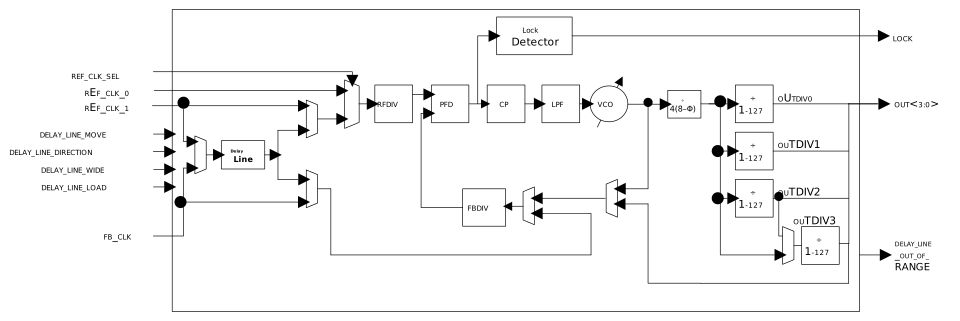
The delay line has 256 delay taps. Each delay tap is designed for ~25 ps steps. The delay taps are not process, voltage, and temperature (PVT) compensated. For characterized value, see the respective PolarFire FPGA Datasheet , RT PolarFire FPGA Datasheet , PolarFire SoC FPGA Datasheet , or RT PolarFire SoC FPGA Datasheet . Delay lines have two modes of operation—narrow and wide. In narrow mode, 128 delay taps can be programmed, and the resolution is 1 tap per each selection. In wide mode, 256 delay taps can be programmed, and the resolution is 2 taps per each selection. The values for the delay lines are configurable using the CCC configurator, and are programmed during device programming.
Delay lines can be dynamically fine-tuned by the fabric signals, DELAY_LINE_DIRECTION, and DELAY_LINE_MOVE. The dynamic tuning on clock outputs can be re-loaded to the pre-programmed value using the fabric signal, DELAY_LINE_LOAD. The mode of the delay line is configurable using the DELAY_LINE_WIDE signal. On the rising edge of DELAY_LINE_MOVE, the delay line increments or decrements its delay taps based on DELAY_LINE_DIRECTION and DELAY_LINE_LOAD. For more information on delay line control signals, see PLL Port Description.
The total delay is a function of the number of delay taps configured and the time value of each delay tap.