
3.1.26 Current Conversion Factor
The current conversion factor is used when converting an internal current quantity to an external equivalent RMS current quantity. K_Ix: where x = [A, B, C or N].
For proper ADC function, the differential input voltage proportional to current must
be provided by the current sensor (typically a CT in conjunction with a burden
resistor). This differential input voltage (Vdiff = V+
- V-) must be scaled so that its peak input value is
limited to the maximum acceptable ADC input voltage:
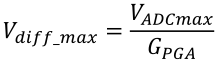
The maximum acceptable ADC input voltage is specified in the Data Sheet of the device. For example, in the case of ATSENSEs, the limit input value is 0.5V for an ADC PGA gain of GPGA = 1 or 62.5 mV for an ADC PGA gain of GPGA = 8.
The maximum differential input voltage must typically not exceed 0.5V (V+ = 0.25V, V- = -0.25V). However, acceptable performance may be achieved with signals as high as 0.55V or slightly higher. The ADC saturates at Vdiff ≥ 0.6V. When using single-ended inputs, a single-ended input of 0.5V may be used. However, the highest accuracy will be achieved by limiting single-ended input voltages to 0.25V to avoid introducing non-linearity due to approaching forward conduction of input protection diodes. Reduced input voltage range signal on current input channels may use the programmable gain amplifier to recover input range. In typical applications, external scaling allows for an appropriate over-current factor to maintain linearity during over-current events.
The ADC input voltage is, then, converted by comparing it to the reference voltage VREF, specified in the Data Sheet of the AFE selected. This comparison creates an additional ADC internal input conversion gain, 1.0V/VREF, due to ratio-metric effect of the reference voltage, approximately 1.0 / 1.2 in the case of the ATSENSE, which is part of the ADC conversion factor and is taken care of internal to the DSP processing and is separate from the current channel calibration factor, CAL_M_Ix.
CT Sensors (Current Transformers)
For example, it is desired to have a max measurement current of 240 ARMS (200 ARMS + 20% over-current). The following three steps must be taken (this example assumes use of a CT turns ratio, Te= 2500:1 (200 ARMS : 80 mARMS) and a GPGA = 4):
- Determine total current
burden resistor value, as if it were one single-ended input, then divide by
2 for differential burden resistors:

Each one of the two burden resistors (for differential inputs) would be selected as 0.46Ω.
- Next, determine the current
conversion factor (the equation shown, first, is the long-form
definition):

When using CTs with a burden resistor, the equation for K_Ix simplifies to (the preferred equivalent short-form):

Where, Te= CT equivalent turns ratio.
- Finally, to compute an
equivalent external current, multiply an internal Qformat number,
IINTERNAL, in the following fashion:

Rogowski Coil Current Sensors
Rogowski coils produce an output voltage proportional to the time derivative of the current being measured and exhibit a gain proportional to the frequency being measured, f, as well as a 90° phase shift relative to the input signal. A 50 Hz signal would have 5/6 the gain as an equivalent 60 Hz signal in addition to the phase shift. The metrology DSP includes a selectable DI (Digital Integrator) to process all current channels using Rogowski coil sensors and introduces a 1/f gain response and an ideal -90° phase shift to compensate for derivative nature of Rogowski coil sensors. The DI (Digital Integrator) filter is adjusted for unity gain at 60 Hz.
For example, it is preferable to have a max measurement current of 240 ARMS (200 ARMS + 20% over-current). The following steps must be taken (this example assumes use of a Rogowski coil with an output of 500 µV/A at 60 Hz (or 416.6 µV/A at 50 Hz) and a GPGA = 4, operating at a frequency of 50 Hz):
When using Rogowski coils, the equation for K_Ix simplifies to (the preferred equivalent short-form):

where, ksf = Rogowski coil scale factor.
For this discussion, the scale factor, ksf, is defined at the reference frequency, fr = 60 Hz due to the DI (Digital Integrator) filter was designed for unity gain at 60 Hz. If it is preferred to use ksf defined at another frequency, the gain of the DI filter must be accounted for in the computation as follows:
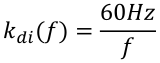

where,
- Ipr = primary rated current
- Vsr = secondary rated voltage
- f = frequency of operation [Hz]
Refer to the “PIC32CXMTx Metrology User Guide” (DS50003460) for additional information.
Resistive Shunt Current Sensors
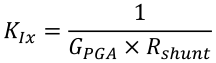
A resistive shunt current sensor produces an output voltage proportional to the current passing through it. Generally, if a shunt is used for measuring the active phase current, then the voltages of the shunt are at the high voltage of line phase being measured and the relative metering ground reference is usually connected directly to that line phase voltage to keep all voltages going into the PIC32CXMx or ATSENSE device at the same relative voltage level. This means the voltage of the neutral line is divided down to a fraction of a volt, relative to the line phase voltage.
Example:
If Rshunt = 100 µΩ = 0.0001Ω and GPGA = 8, then:
KIx = 1000000 / (8 * 100) = 1250
The metrology firmware uses uQ22.10 to represent both integer and fractional numbers, so set:
K_Ix = ROUND(1250 * 210) = 0x00138800
| Name: | K_Ix |
| Property: | Read-Write |
| Bit | 31 | 30 | 29 | 28 | 27 | 26 | 25 | 24 | |
| K_Ix[31:24] | |||||||||
| Access | R/W | R/W | R/W | R/W | R/W | R/W | R/W | R/W | |
| Reset | 0 | 0 | 0 | 0 | 0 | 0 | 0 | 0 | |
| Bit | 23 | 22 | 21 | 20 | 19 | 18 | 17 | 16 | |
| K_Ix[23:16] | |||||||||
| Access | R/W | R/W | R/W | R/W | R/W | R/W | R/W | R/W | |
| Reset | 0 | 0 | 0 | 0 | 0 | 0 | 0 | 0 | |
| Bit | 15 | 14 | 13 | 12 | 11 | 10 | 9 | 8 | |
| K_Ix[15:8] | |||||||||
| Access | R/W | R/W | R/W | R/W | R/W | R/W | R/W | R/W | |
| Reset | 0 | 0 | 0 | 0 | 0 | 0 | 0 | 0 | |
| Bit | 7 | 6 | 5 | 4 | 3 | 2 | 1 | 0 | |
| K_Ix[7:0] | |||||||||
| Access | R/W | R/W | R/W | R/W | R/W | R/W | R/W | R/W | |
| Reset | 0 | 0 | 0 | 0 | 0 | 0 | 0 | 0 | |